Tuesday, 20 April 2021

Lunchtime Blues

There’s something queer about the food these days. You go to a restaurant to eat and half of the menu is designed for some kind of wedding feast. It’s all got cutzey for some reason. Perhaps the Michelin Man is seated at table number seven. What’s wrong with ‘sat’?

In the good ol’ days, food was food. No cream doodah then, no fennel sauces or roasted swedes. Nothing served in a ceramic spoon, for Goodness sakes! Simple stuff. A salad was lettuce, sliced onions and tomatoes with a heavy and oily aliño; now it’s got enough different kind of vegetables rattling around the plate to make a rabbit blanch. The main course used to be a plate of what one hoped were mutton chops (or were they perhaps goat?) or slices of pork, or perhaps a plate of chicken knuckles with chips.

* How to prepare chicken knuckles. Take one chicken, have at it with an axe, then drop result into a sartén with plenty of oil, peppers and garlic. Fry to taste. Riquísimo.

All the local joints could manage this simple fare, and with a bottle of gritty wine, the whole thing plus pan came to around sixty pesetas a head. Thirty cents European. Now, what’s wrong with that?

There was no menu and no price list. If you didn’t know what you wanted, or couldn’t understand the waiter, you wandered into the kitchen and pointed.

In those days, if we wanted a decent roast for home, we’d have to drive to the nearest butcher. He was a blood-spattered German trading six hours down the coast in the Calle San Miguel, Torremolinos’ famous high street. We’d fill up the plastic freezer box, spend a night or two on the tiles, and then head back up the coast with a headache the following day.

The twenty or so who made up the foreign community in the village in those days would be waiting for us on our doorstep when we returned. One of them was a retired air vice-marshal with a plummy accent called ‘Tabs’. My parents had left the door ajar one particular evening and had gone round the corner to the first and only foreign bar for a nip while the roast roasted. Tabs, on his way up the hill for a pink gin, smelt the rich smell of the roast waftin’ on the evening air and stopped by the house to invite himself to dinner. He went in and found no one around, so he checked inside the oven – as one does - to have a look at his potential dinner. Satisfied, he carried on to the pub for a large one and to obtain an invitation from my mother, in which he was successful.

Now our oven was one of those old Butano three burner ones with a lid and a slight wobble. When the hungry party returned an hour later to check on the roast’s progress my mother found that Tab’s tour of inspection had, by briefly opening the oven door, put out the gas. Tabs later recalled that ‘no one from the lower ranks had ever talked to him like that before’.

The milk in those days was undrinkable. It came in two litre glass bottles with a thin neck. There was a slightly blue cast to it due to the fact that the manufacturer had substituted the cream for pork grease and added formaldehyde to keep it stable. This baby could sit in the sun all day. Tea, if we could get it, came in teabags brought out from England loose in people’s luggage, wrapped around the socks. Eggs and chips were the standby at home, and cocido in the restaurant in the square. Tabs would insist on the plates being warmed, without much success from the kitchen-wallah, so he would usually place his plate under his shirt for a few minutes to do the job. ‘Under trying circumstances’, he would say, ‘one must keep up appearances’.
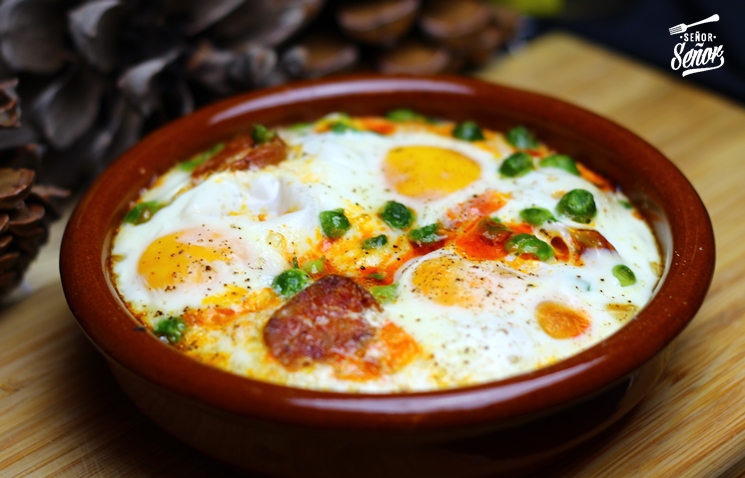
Another dish of the time remains to this day a favourite of mine, although it is now extremely hard to find. You see, it’s too cheap. This is ‘Huevos a la Flamenca’, a small earthen dish with ham or some kind of donkey-sausage served with peas, peppers and a fried egg. The whole, cooked in tomato paste. I happened across one the other day outside Granada: delicious!

Food, back in those days, was scarce and no one was going to mess around with sauces. Actually, come to think of it, it may have been because you couldn’t get cream. Eggs, tomatoes, potatoes, peppers, salchichón, chicken and pork was about your lot. The local grocers, known in a gesture of Spanglish relations as ‘The Foodings’ had a few tins on the shelves plus ‘Spanish’ bread, truly awful chocolate, some rather nasty looking sardines and a rack of wine in returnable bottles (two pesetas back). They’ve still got the chocolate. Credit was extended to favoured customers; a dried lima bean went into your jar for each five peseta 'duro' owed. This system was eventually overturned – literally – by an escaped chicken that broke into the store one night. Reportedly, it ate most of the evidence.

Tapas, even more than today, were the solution. One can always get a bloody good tapa in Andalucía with your quinto or your tinto. A piece of magra - lean pork - with some chips and bread. Two fried cordoñíz eggs on toast. A ham, cheese and alioli cherigan. A small plate of whitebait... a fat chunk of tortilla de guisantes... home made potato crisps (when was the last time?)... a few of those would set you up nicely.

These days, eating at a restaurant can be confusing (without worrying about wearing one's face-mask) Rather than asking 'what's on', you'll be handed a massive sticky book in several languages. The deep-freeze must be huge to store all those things on offer. If you came to talk and enjoy your meal, you'll need your glasses first. I always order what the other person's having - unless, of course, they've got Huevos a la Flamenca.

English as She is Spoke

A thoroughly modern entity like the European Union should have its own official language. Currently, we have the agreed number of ‘24 languages as "official and working": Bulgarian, Croatian, Czech, Danish, Dutch, English, Estonian, Finnish, French, German, Greek, Hungarian, Irish, Italian, Latvian, Lithuanian, Maltese, Polish, Portuguese, Romanian, Slovak, Slovenian, Spanish and Swedish’ (Wiki). Since few of us can speak all these, plus the many other tongues preferred in various bits of the union (including Catalonian, Valencian, Basque, Galician and around another ninety palavers and a further fifteen major immigrant languages), we generally settle for English, French, German and (to a degree) Spanish. Everybody, hopefully, speaks at least one of these.

EU rules – designed not to offend – mean that products have to carry the local language on their merchandise, which is why Kleenex for example says tissue, mouchoir, pañuelo and, er, Papiertaschentuch and so on in 24 languages. The main reason, I think, that the EU can’t grow any more is that there isn’t any more room on our boxes.

That’s also why there are three labels of closely-worded text on the inside of one’s trousers saying ‘Do not Bleach’ in a veritable Babel of lingos.

Europeans are generally unfazed by foreign languages (many readers of the Business over Tapas - my weekly news-bulletin - have English as a second language). Although this may not be entirely true of the British who always view learning languages at school as a rather futile exercise rather than something which may one day prove useful.

Probably because they started us off on Latin (some of us). Still, we have our pride.

From Connections France this week comes the slightly silly ‘Expat campaigners: Help us bust myth of boozy Brits abroad’. We read there that ‘Britons abroad are not all wealthy boozers who speak no foreign languages…’.

Actually, and take it from me, some of the Brits here in Spain not only don’t speak a word of Spanish, they can barely speak their own language. 

Even when they're sober.

Seriously though, despite the UK no longer being a member of the EU, English remains the first language of use, says Forbes here. It says ‘As of 2012, a majority of EU citizens (51%) could speak English, either as a first or second language. It was the only language that could realistically be used as a mode of communication, given that only 32% can speak German and 26% can speak French’. As we wait for newer statistics, they estimate that around 50% of Europeans can speak English ‘as a second language’ today.

I believe that the language of culture, maybe thanks to Hollywood, is English. Who wants to see Humphrey Bogart in translation, or listen to Frank Sinatra without understanding the words?

But can you have English as the de facto language of 446 million people following Brexit?

There are no countries currently within the EU who use English as an official first language, although we might be splitting hairs here (Ireland has Gaelic and Malta has Maltese as their ‘official languages for EU purposes’). Within the Schengen Area, and we must again tweak the facts, only Gibraltar speaks English as its first language. Maybe one day we shall be obliged by the pedants to say that ‘in Europe, we speak Gibraltarian’.

In reality, of course, we speak American. Just don’t tell Shakespeare.

Buck Naked

Recently, a gentleman decided to walk from Land’s End to John O’ Groats, a journey of around a thousand miles. It’s a pleasant enough route, I once did it on a bicycle. The news, of course, isn’t the peregrination of this fellow per se, so much as in the way he was dressed. Or rather, wasn’t. The first time I read about him, in a copy of an unsuccessful magazine called ‘News from Home’, I thought it said that he was a ‘naturalist’ and that he was one of those bearded people who wanders about clutching binoculars and wittering on about the sexual habits of rabbits (which I suspect are pretty straightforward) and followed by a patient, philosophical and faceless cameraman whose main job is to not get noticed, leap-frog in front of our hero, and watch for his shadow in the action shots. However on examining the photograph, and re-reading the piece, I found that the ambler was a rucksack-toting ‘naturist’, or one of those people who enjoys wandering about nude in public.

I once got to know another example of this tendency in Mexico. This chap enjoyed diving in the warm Pacific waters in search of lunch. He also favoured what I would describe as relative nudity. He would wear an oxygen tank, a mask, a wheezer, a vest full of handy pockets, a waterproof watch (good to five hundred metres), a weight belt, fins and a large knife strapped to his right leg. Practically the only part of his body visible to the casual onlooker was his knob.

And here we find the difference between nudists and what are apparently known in Spain as ‘textiles’. A nudist is not interested in ‘going as he was born’, but to leave uncovered the parts which are normally covered.

Nowadays, of course, the only item of clothing forced upon them by cruel society is the face-mask.

You can say that someone wearing underpants is dressed, whereas someone who is covered everywhere except for his genitalia is either a pervert or a ‘naturist’. I wouldn’t want to mix the two concepts; perhaps the difference is in the presence or otherwise of a macintosh.

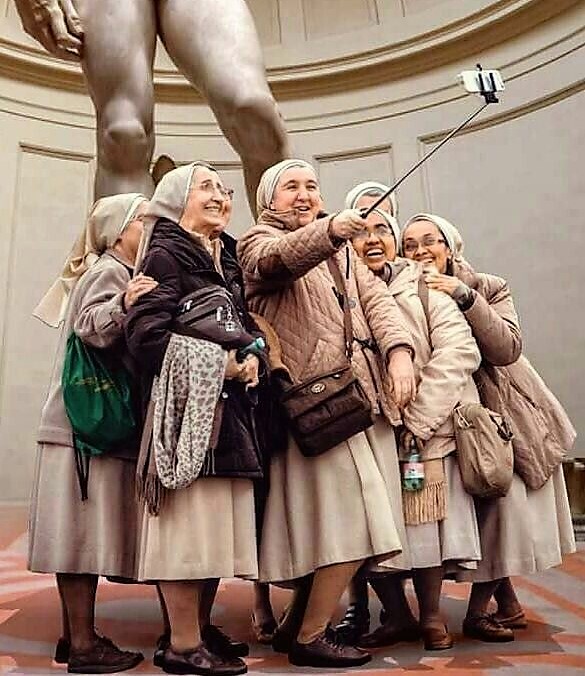
The consideration of the nude body, away from the sexual angle, offends nobody. In fact, the reverse. Michelangelo’s David is one of the most sublime examples of art in the world. There is no championship of the sexual organs: he’s just young, brave and inspirational. The same effect would not have been reached by the sculptor if he’d chosen a fat old gentleman with a pot.

Goodness knows, there is nothing wrong with wandering around naked in your own house or in other private places knowing that you are not going to be seen by unknown people. Nudity bothers no one in a controlled environment. I remember once sitting in the sitting room (what else is there to do there?) with my newly-wed, both of us naked, when someone banged on the door - a Swede as it turned out looking, I think, to borrow some money. The only item of apparel available to me at that moment was a slightly affronted cat which I held (gingerly) in front of my bits. The Swede didn't stay long, I'll give him that.

But here’s the rub about naturism: the entire group (they insist on wandering about in gangs) knows that they are a herd of people highly conscious of the fact that they disturb the majority of society – not in small part due to the evidence of their small parts. Sadly, few of them look like David the Statue or Britney Spears.

‘Ah, but we don’t look’, they say.

Yeah, yeah.

Naturists say that ‘clothes don’t make the person’ and that they can liberate themselves from the mundane competition of appearance. Unless they’ve forgotten to take off their Cartier or Rolex, it’s true that they can successfully manage to hide their position in society. Like anyone cares.

But, everything in its place, as the saying goes. During the eleven and a half months of the warm season, the shops and banks are filled with half-dressed Englishmen, in socks and y-fronts, standing patiently in queues or pushing trolleys full of beers, whisky and digestive biscuits. I’m usually obliged to pretend that I’m Swedish.

That overweight fellow over there sweating into the lettuces isn’t one of ours, and, no Señora, I don’t even speak his language. Actually, he probably feels overdressed, why, just last week he streaked – or at least waddled – across a football pitch.

But that’s my own particular Calvary. I don’t happen to live in a nudist colony and I certainly can’t imagine, as the joke goes, where they keep their money.

For practical reasons, when the weather is hot, I’ll grant that you have to remove some clothing (with the local social limits in mind), but, when it gets cold, I reach for a sweater. No worries. But them?

They eat.

A few years ago, my accountant invited me for lunch at a naturist restaurant on the beach. Despite recommendations to the contrary from the specialized magazines on the subject, I didn’t feel entirely comfortable in the beach-bar, clothed and surrounded by naked Germans tucking into their paella and chips. I hadn’t the least desire to take off my apparel. Apart, that is, for my shirt which I had inadvertently stained with tomato sauce. Everybody was staring at me as if I was the nutter. We were sat – or in some cases fastened by sweat – to metal chairs. Yes, there were a couple of girls at other tables who weren’t bad, but we were eating, for Goodness sake (the moment when I first managed to raise my eyes and see them was, coincidentally, the moment I had the accident with the tomato sauce). Two hundred people staring at me like I’m peculiar and I don’t think it was down to the cigarette handily wedged behind my right ear. Then, during the pudding, a man from the next table suddenly rose to his feet in an evident state of excitability. Jaysus, gimme a light...

I changed my accountant the following day for an Argentinian one. A dressed one. I believe he even wore a tie.

¡Perfecto!

Unfortunately, he soon stole everything I owned, including my clothes.

Which explains why I go around this way. It’s not because I like it, see, it’s because I have to.

Friday, 19 March 2021

A Licence to Hunt Frogs

In the old days, it was easy enough to find frogs. They would be croaking in some corner of the garden or leaping into a nearby pond. Sometimes there would be hundreds of miniature amphibians, perfect but tiny, wandering around the edge of a pool as if on their first morning stroll. Nice little chaps, frogs.

‘I say waiter, do you have frogs legs’.

‘Oui, monsieur’.

‘Splendid. Hope over the counter, would you, and get me a sandwich’.

I had read in the paper that a large pond in some pueblo in the province was full to bursting of ‘renacuajos’, tadpoles. It would have been what editors call ‘a slow news day’. The reason this interested me was because we have had a lot of mosquitoes lately and if there’s one thing that enjoys a good meal of these horrible insects, it would be frogs. The bugs are out now, and biting. Besides which, the pump in our swimming pool is bust so I can’t empty (and paint) the piscina and I don’t want to get into trouble and be blamed for the clouds of mozzies by the neighbours. I also want to do my bit for the environment, so won’t be buying any nasty sprays. Best thing for everybody would be a shovelful of frogs tossed into the deep-end.

All I needed to make this plan a success was a bucket-load of the little critters collected from the local pond or some handy reserve of stagnant water.

In the old days when I was a boy and first exhibiting an interest in the small animals and insects that surrounded me, I would catch a few sticklebacks with a jam-jar and a bit of string while wearing flannel shorts and Start-rite shoes stuck gamely in some mud. This would be a rather hit or miss affair at best; but now I am glad to say that I am rather more hi-tech in my hunting.

I get my boy to do it.

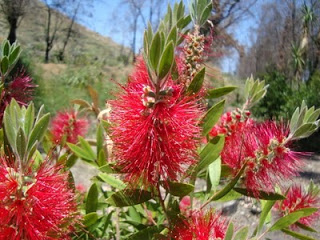
We are spoilt for choice at the moment, with lakes, ponds, pools, gullies, reservoirs and endless puddles all full from the heavy rains over the past months. This blessing from the skies, apart from causing a welcome surge in the roof-repair business locally, has brought a wondrous crop of wild flowers to stipple the hills and fields with every colour that Nature can imagine, and is now causing the first stirrings of insect-life, bees, butterflies, glow-worms, dragon-flies and, of course, mosquitoes.

It was a warm day and there wasn’t much doing so we went down to the ‘creek’ up past Turre, where the steep and narrow bridge dog-legs over the gulch, at the narrow bit of the Rio Aguas as it splutters its way down from the snowy mountains far inland. There’ll be frogs there. You can park the car off the road at the top in some handy ditch, deep in a patch of wild flowers. The descent to the river-bed is tricky, as it’s all overgrown, but we made it safely to the bottom, jam-jars and bits of string quivering with excitement. Years ago, there used to be small black terrapins living down there and it was worth the odd inconvenience of a shoe full of water to catch them. Now, in a small and localised example of extinction, there’s none left. Just water-boatmen, caddis flies and mosquitoes perched in the branches of the trees. It is a peaceful place down there under the bridge, although something felt wrong, as if we were being watched. A bit creepy. We saw the dried husks of some dead swallows tossed violently around in the undergrowth. There didn’t seem to be any frogs about so, unsettled, we soon left.

We drove back and went down to the riverbed near our house, where the winter rains have collected into what turns out to be quite a large lake. The gravel-grovelers in the rambla appear to have built this for some reason or other with their bulldozers and tractors. There were some large aquatic birds scudding across the surface and I heard the call of a lone bullfrog but we couldn’t find much sign of life once we had climbed down to the edge, apart from the floating body of a dead goldfish. How on earth did that get there?

The town hall will need to spray this expanse of water soon, as the season’s mosquitoes are larger than normal and they are getting hungry. Perhaps the dreaded global warming or something strange in the water is doing it. The story is, and you may have heard this already, the mosquitoes are so big this year that their wings have atrophied and they have lost the power of flight. They are said to run along the ground after their pray, like asthmatic rabbits. Two or three bites from these things can easily empty a leg.

We return home and I feed the chicken some dog-food (which it seems to prefer over rooting around in the garden). The eggs are a trifle gamey but they are regularly laid and the shell is certainly strong. You have to break them with a hammer.

There’s a pond way up above the pueblo towards the top of the mountain, guarded these days by a chain. No biggy. I go up there with a bit of muslin to scoop out some tadpoles for my jam-jar. This time, I have some success and bring home a smear of wriggling pond-life which I toss into the bottom of the mostly empty swimming pool. There is an odd moment of suspense before the water begins to bubble and churn. To my surprise and horror, I can see the insect larvae eating the unfortunate tadpoles in a feeding frenzy like something out of an old Jaws movie. I go quickly inside and close the windows.

They are climbing out of the pool now. Using the ladder. The sky is empty of birds. I’ve got a tin of spray, a fly-swat, a plug-in with a little blue pellet and a loaded shotgun. We’ve nailed pieces of wood over the shutters and put a chest of drawers in front of the fireplace. A blond American woman is making us a cup of tea in the kitchen as the first exploratory ‘thunks’ and bangs start at the base of the door in the front room. There’s a crash from upstairs. The radio is babbling some nonsense about horse racing at Ascot.

Where is that helicopter from the town hall? We need some insecticide down here!

The Garden

I’ve never had much interest in gardening. My mother planted ours around fifty years ago and I remember she would spend her time pruning, seeding and either putting things in pots, or taking them out again. She would insist on special earth (wisely, as ours is solid clay) and she would buy her flower pots from a town in the hinterlands called Albox (famous in those days for its Moorish kilns and its industrial concessionaires).

Not to be outdone, my father planted a large number of trees in the field behind and above the house and would water them with big plastic bottles filled at the village fountain and lugged up there in his little Renault.

The property, to begin with, was fed water from a tank supplied by the water-truck from the nearby village of Turre. It would then be noisily pumped into the house as occasion demanded. Much later, we got mains water from a local agency and, when that company became a part of the current water supplier, all of the 10,000 public shares from the agency, shares that each family or business were obliged to hold in our pueblo, worth 500 euros or so each in modern money (we had nine), were – whoops! – lost in the best local tradition.

Never mind, we had water, and for many years a gardener, Cristóbal, who squirted everything with enthusiasm, explaining that ‘of course the flowers fall off when you spray them, they’re flowers’. Cristóbal fancied himself as being the wise old Son of the Soil and would laugh as my mother lost her temper with him, ‘But Señora, how can you know? This is Spain!’

He had another problem, being partial to watching the women as they lounged around the swimming pool. One time, a scantily clad house-guest marched up to my father to complain that the gardener had been peeking at her while she was having a shower. My dad threw her out, claiming that it was much easier to get another house-guest than it was to find another gardener.

But that was then. My parents both died and, after I married, I took over the estate.

In fact, as far as gardening was concerned, the estate pretty much looked after itself. Between the rare rain that falls here and the even rarer moments of me watering with an increasingly leaky hose, the garden was obliged to make its own way. The smaller stuff died out and the stronger plants survived and spread.

Twenty agreeable years passed and the garden was by this time violently overgrown and, in the opinion of at least one of the larger pepper trees, in need of a miracle.

In the summer of 2009, a brush-fire raced across the entire municipality, pushed along by a high wind. The garden got its miracle all right, and I was left with a sad mixture of charred firewood, soot, dead trees, charcoal and smoking stumps. We lost several out-buildings and some neighbours lost their homes and the cars. 2,500 hectares went up that evening. The town hall reacted magnificently – by doing absolutely nothing at all.

Except asking the Junta de Andalucía to underwrite a press campaign to re-fill our hotels, which had emptied following the blaze. Not an election year, then.

But that’s why we love it here. They only remember you when they want something.

The garden slowly returned as green bits appeared amongst the sludge. A bush survived here and it looks like a tree pulled through over there. Most of my Dad's trees had gone, but we had plenty of firewood to cheer us up. A few months later, I was standing with a few people with axes and saws under a huge dead pine tree which there and then fell over and smashed a half-ruined shed on the other side from us.

Death felt our collars that day, but moved on.

The garden needed lots of work and, in need of some daily exercise, I took to clearing the place up. A dozen years later, it goes on, with me cutting down dead branches, planting, pruning and watering the grown-up seedlings of whatever survived that long-ago fire.

Oddly enough, that pepper tree was right, it does look a lot better now.

A Short Drive in the Car


Spectacles, testicles, wallet and watch, combined and in noisy pantomime, appear to be a way of remembering how to cross oneself successfully. For me, they are a simple mnemonic to remember to leave the house properly equipped. As age creeps up upon me, I find I forget things. Like not doing up my flies or forgetting to brush my hair, or coming out without my glasses. However, there is nothing more irritating than driving down to the shops only to find that I had left my wallet at home. And while it is useful to know what time it is, and therefore if the shops are open or not, I depart from the list by not wearing or indeed owning a watch. One day, when they invent watches that tell us what year it is, then maybe I’ll reconsider.

So, my four stations of the cross have morphed into: zipper, not that this is really my immediate concern - unless of course I am entertaining, spectacles, wallet... and face-mask.

The face-mask brings its own luggage to going anywhere. First of all, it steams up the glasses. No problem in the car, of course, but then you don't know that you've forgotten it until you get out at your destination.  Walking means I must hold my breath while I try and see where I'm going, then letting it all out with a sudden whoosh while gamely waiting for the specs to clear.

Thus, being new to my requirments, I forget to bring it along more times than I remember. There is nothing worse than driving down the lane, then remembering you forgot your mask, and having to turn round to go home again with the air of somebody who knows exactly what he's doing - rather than being an absolute chump. The neighbour is still leaning over his fence as I return. 'Nice day', I tell him for the second time in three minutes.

Unfortunately, a knot in a handkerchief won’t do. Firstly, because I would have to remember to carry a hankie, and secondly, because my list of vital things to retain before I leave the property turns out to be rather longer than the modest accumulation of paraphernalia mentioned above.

Wearing a tee-shirt and jeans doesn't help either with extra storage. My pockets bulge when I'm in public like I've just been on a shop-lifting spree in a candy store.

See, I need two pairs of glasses, one for reading and the other to keep the sun out of my eyes. These sun-glasses, usually originally belonging to somebody else - you know how it is, in the old days it used to be lighters - often tend towards being bent, scratched or hopelessly unfashionable; but they are useful in the summer, especially if I find I need a short nap while talking to the vicar.

I like to carry a mobile phone. Mine is an elderly model much like myself and it, like me, has a short battery life – a couple of hours or so – and is rarely charged when I am. This makes it an optional item on my list.

Keys of course: car-keys, the house-key and that strange one on the key-ring that no one remembers where it came from. I must also bring with me an ID, which, and thanks to the polizie, means both a passport and the green A4 letter from immigration saying that they care. So much easier than the old Residents Card which I carried about with me for forty years. I suppose I could put my name down for a Foreigners Identity Card - a TIE as it's called - and slip effortlessly from a second class European to a third class extranjero, but  perhaps another time.

My pockets are filling up. I’ve brushed my hair and had a pee. I've done my Four Stations again: money, ID, keys and a nice clean mask. Shut the dog away and checked that the door is locked. I’ve got the plastic shopping bag out of the kitchen (no sense in wasting three céntimos), turned the water off in the garden (hah!), put the chicken back in its cage, eaten its egg, checked my pockets again… and am now ready.

But wait, I’ve forgotten where I had planned to go.


Joe Bloggs

Spain has four special names for unknown or forgotten people: these are Fulano, Mengano, Zutano and Perengano. The most used is Fulano, 'Whassisname', which comes, apparently, from the Arabic: fulān which means 'anyone'.

Mengano, or 'Whojammie', is also from the Arabic man kān and means 'whoever'.

The other two names, 'Thingy' and 'Spike' are used less. The first, Zutano, may come from scitānus, Latin for 'wise one', but it's anybody's guess about Perengano.

The Spanish use these names for handy reference. The first two of them, Fulano and Mengano, above all.

The diminutive version, Fulanito, is particularly useful for jokes, along the lines of 'little Jimmy'.

The female of Fulano, Fulana, is used (as is always the way) pretty much exclusively to mean a puta.

And now, looking at Wikipedia, I find all sorts of other versions, in every language: including Miðalhampamaður from the Faeroe Islands.

I know, time to go and feed the horses...


Everything That's Runny Contains Water

I saw a billboard today while driving along the main road towards the playa on my way...