Sunday, 28 May 2023

I’ve been Dubbed, Subtitled and Translated into Sign-language


It seems that we can blame that old sod Franco for the size of the Spanish dubbing industry. Where other countries tamely put subtitles on their cinema or television screens, the Spanish are much more partial to James Dean’s mouth making a ‘hi’ movement as a strange and gravely Madrid-accented voice says ‘hola, ¿que tal?
 
There are those who are surprised to discover how their favourite star really sounded - think of Humphrey Bogart or Homer Simpson.
 
Sometimes, they don’t even remove the original soundtrack – just turn it down with the Spanish version bellowed out on top. There’s David Attenborough telling us about snakes in his whispery voice – which at least this viewer can – or at least could understand – if it wasn’t for the same bloke from Madrid thundering out something about serpientes venenosas rendering the whole thing impossible to understand in any language.
 
Franco didn’t approve of foreign languages – Basque and Catalonian of course – but anything else either. They might be saying something untoward, immoral or revolutionary. So he banned them. No one was to speak anything but Spanish – including the nation’s deaf, who were not allowed to use sign-language (and even today they sign in a rather furtive sort of way, as if they are still on the look out for a Guardia Civil).
 
So, forget subtitles, everything imported had to be dubbed. Except, come to think of it, pop music. It would have been a stretch having our friend from Madrid crooning ‘she loves yer ya ya ya’ in castellano over the Beatles. I can’t see many people buying the record either.
 
Anyway, in some cases, films were translated away from their original meaning – if immoral or faintly subversive – and represented in a more acceptable light. ‘She’s my girlfriend’, for example, might safely become ‘she’s my fiancée’. Of course, if the film strayed to far from the Catholic Church’s view of morality, or the Government’s view of political propriety, it would never be shown here anyway. Which is why everyone had to drive up to Perpignan to see Marlon Brando’s ‘Last Tango in Paris’ and why, between the death of Franco and the arrival of the Internet, they sold porn films by the lorry-load out of the Spanish gas stations.
 
Dubbed porn films, if you can imagine such a thing.
 
Televisions now have this special button for those who wish to see something in its ‘versión original’. Press it and – whoops – up’ll come the show in all its glory. My Spanish step-son, who is learning English and is fond of Bob Esponja, inexplicably refuses to avail himself of this useful service of switching him into SpongeBob SquarePants. Perhaps he doesn't want me to get the joke.
 
Of course, humour don't always translate, which makes watching Friends or Frasier a bit hit or miss when enjoying the Spanish version. And anyway, Niles was funny because of his voice!
 
The dubbers, there must be a small coterie of them working out of a cellar underneath a multiplex in Madrid, are usually unknown - until one of them ups and dies. Then the media will tell us that Paco Orbera was the beloved voice of Errol Flynn, Fred Flintstone, The fellow with the big chin in Gunsmoke and Bruce Willis.

In the City, there will be a few cinemas that show films in ‘V.O.’ with subtitles, usually lowbrow romantic comedies. They do well with the American students.

Now, for all I go on about the desecration of Die Hard ('Jungla de Cristal' for some reason) by the dubbers - who I think must have some kind of cast-iron contract - at least the Continentals are prepared to look at foreign cinema, as well as their own (and the Spanish make quite respectable movies). In Britain, we think that everything good, if not ours, comes from Hollywood. When was the last time you saw a French film, an Italian TV show or a Spanish documentary? Bloody Americans – if there’s a decent European film out there, they’ll churn out a re-make (gotta have that Tom Cruise as the Good German who wants to murder Hitler).
 
In Greece or Portugal or Denmark or Poland (well, I’m guessing about Poland to be frank), you’ll sit down with the local version of popcorn and watch the movie in its original language, the subtitles wobbling there at the bottom of the screen and – in the Mediterranean cinemas at least – with the entire audience talking at once. It's just Spain that's being contrary over this.
 
I suppose dubbing can be useful. The first thing I learnt in Spanish was ‘Hands up’, which I have to admit that I’ve still yet to use in my private capacity. A German friend once told me that he’d learnt English from listening to pop music. Apart from coming out with some odd expressions occasionally ‘(‘Baby, light my fire’, ‘you’re my Rockafella’ and so on), he managed a certain fluency without, apparently, an undue amount of effort. Perhaps some of my readers might want to follow his example and start practicing singing along to Miguel Ríos or Camilo Sesto (If I were you, I’d save the Flamenco until a bit later).
 
And thus the dubbing industry, started and encouraged by Franco, had, by the time of his death, become so powerful (in a relatively small field) that it has managed to continue on into modern times.
 
One rare occasion when subtitles are used outside of entertainment is when a Catalonian politician holds forth on the TV, and his pronuncios are posted below: usually too briefly to be read. Curiously though, when a Catalonian politician wants to appeal to the larger public about something other than politics, why, he’ll address us in Spanish. This does not happen in the Basque County, however, where all declarations, political or otherwise, are made in Spanish.
 
Perhaps they don’t have a good subtitling service there…

The Village Vote


Insults and discovery on the one side, triumphs and cat-calls on the other – it must be getting close to election-time.

Those few of us foreign residents who either have the vote or will be voting in the municipal elections to come on May 28th will be doing so in our town of empadronamiento, which, in most cases, will be a smaller conurbation, perhaps somewhere between a thousand and fifty thousand in size.

We may even know the candidates for mayor (and most probably, some folk from their party-list).

The regional elections fall (in many cases) on the same date. If you follow your local TV, you will see the candidates often enough – at least the one for the party that controls that particular autonomía. Of course, no foreigners are able to vote in these elections, making them for us as hechos de otra pasta – a different kettle of fish.

We return to the local ones.

The party candidates will soon have the list of voters (of course, the mayor has it already) and they will be looking for support. Normally, one votes along family lines, which is simple and obvious enough, and one might be considered locally ‘to have so many votes’ under his roof. There may even be rewards: a job for Junior in the town hall, or at the very least, a post in the gardening squad. 

Sometimes, those who have long moved away to the City will keep their name on the padrón, and thus will vote locally, inevitably for family. We foreign residents with the right to vote (that’s to say, EU citizens and some Brits and Norwegians who have claimed their emancipation) are a bit more tricky as we may not be familiar with the candidates and their little foibles, and might lean towards voting along party lines. Perhaps it’s worth putting one of us guiris on the list, safely towards the bottom, to keep us all in step.

Those lists – a candidature is a party list with thirteen or fifteen or more putative councillors on it – will either be (vaguely) representative of a national party or they could be a local effort: ‘Keep Villa de la Sierra Flat’ or some such thing. The parties with the national support will be handing out free lighters and pens, but may on occasion be obliged to march to the tune called out in Madrid. 

The local ones may be short on the complimentary tee-shirts, but will have more freedom in their message. The results are important for the parties with their headquarters in the Spanish capital. With enough town halls in a given province, the diputación (viz. the provincial council), falls under their control.

The budgets will have been passed for the year, but since no one in the ayuntamiento can be completely sure what will happen this time, there may be a good argument for spending the whole year’s worth of funding before then, which also has the advantage of seducing a few on-the-fence voters as the council fills in the potholes, erects some more street-lights and plants a tree or two.

It’s a murky world, local politics.

I Do Like To Be Beside the Seaside


The weather is just perfect for an early-year swim in the sea. Perhaps if I didn’t live here I would take up my own kind offer and jump off a handy rock and splash about for a bit before staggering out for a refreshing glass of tinto de verano, easy on the ice. However, since I do live here, I tend to forgo the splashy stuff and get straight in to the bar for my order. I mean, it’s still too cold for us thin-blooded locals, and anyway, come to think of it, I haven’t swum in the sea besides a couple of ill-considered visits after an extended lunch for about twenty years.

I may have developed a very slight case of hydrophobia, the fear of water, which is apparently a side effect of rabies. As far as I know, no other signs of this dreadful plague are in evidence on my person and I wonder if it might just be a minor and slow-moving dose that I could have picked up that time I was savaged by a bad-tempered vole which I was attempting to attach to a hanky prior to parachuting the rodent from the roof of the family home while I was still of a tender age. Still, sixty years on and I’m still going strong, no twitches or obvious widow’s peak, although I do like to keep the windows open during the full moon just in case.

The sea is protected by Costas, a selfless organisation that makes sure that the primal brine isn’t sullied by anything beyond an occasional bather while the pristine sands of the coast are free from skyscrapers, dog messes, barns, garages, piers (a huge no-no) and, above all, any suggestion of permanence from those temporary ‘dismountable’ buildings which we call ‘beach bars’. Anything really, much beyond a happy sprinkling of ‘Blue Flags’ which denote ‘excellence’ in the beach facilities, cleanliness, showers and wheelchair access together with no interference in Mother Nature’s soft and salty embrace. So protected is the sea these days, that I wonder exactly what the showers are for – are they like swimming-pool showers, where you are meant to wash yourself down before getting in so as to keep the sea-water clean?

Apparently, the Costas people have decreed that any tussocks of grass which grow on the sand, or any seaweed washed up onto the shore, can’t be removed by the local town halls (except after midnight when the ecologists are all tucked up asleep on their futons). In short, the sea and the beach belong to us all, are to be left au naturel, and we have free access and use for all its treasures, except of course when told differently.

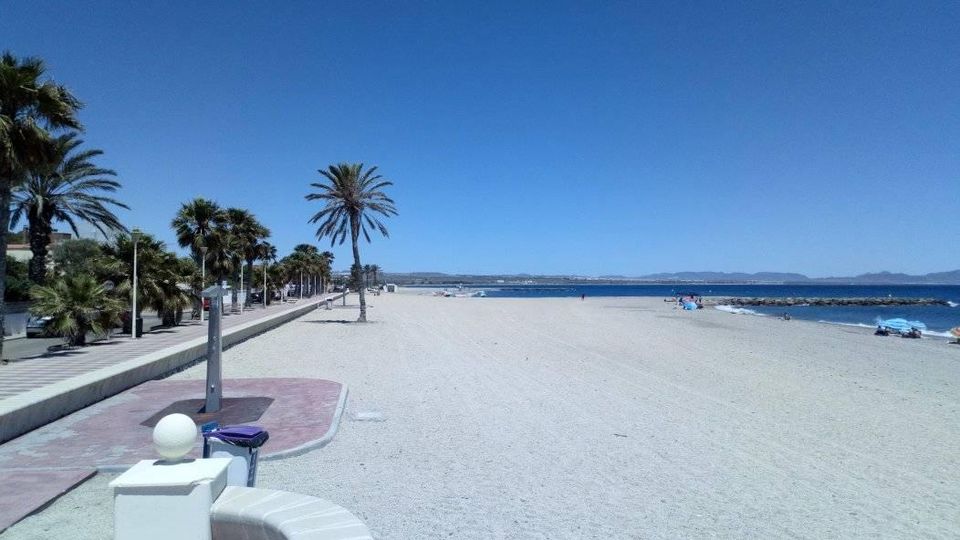
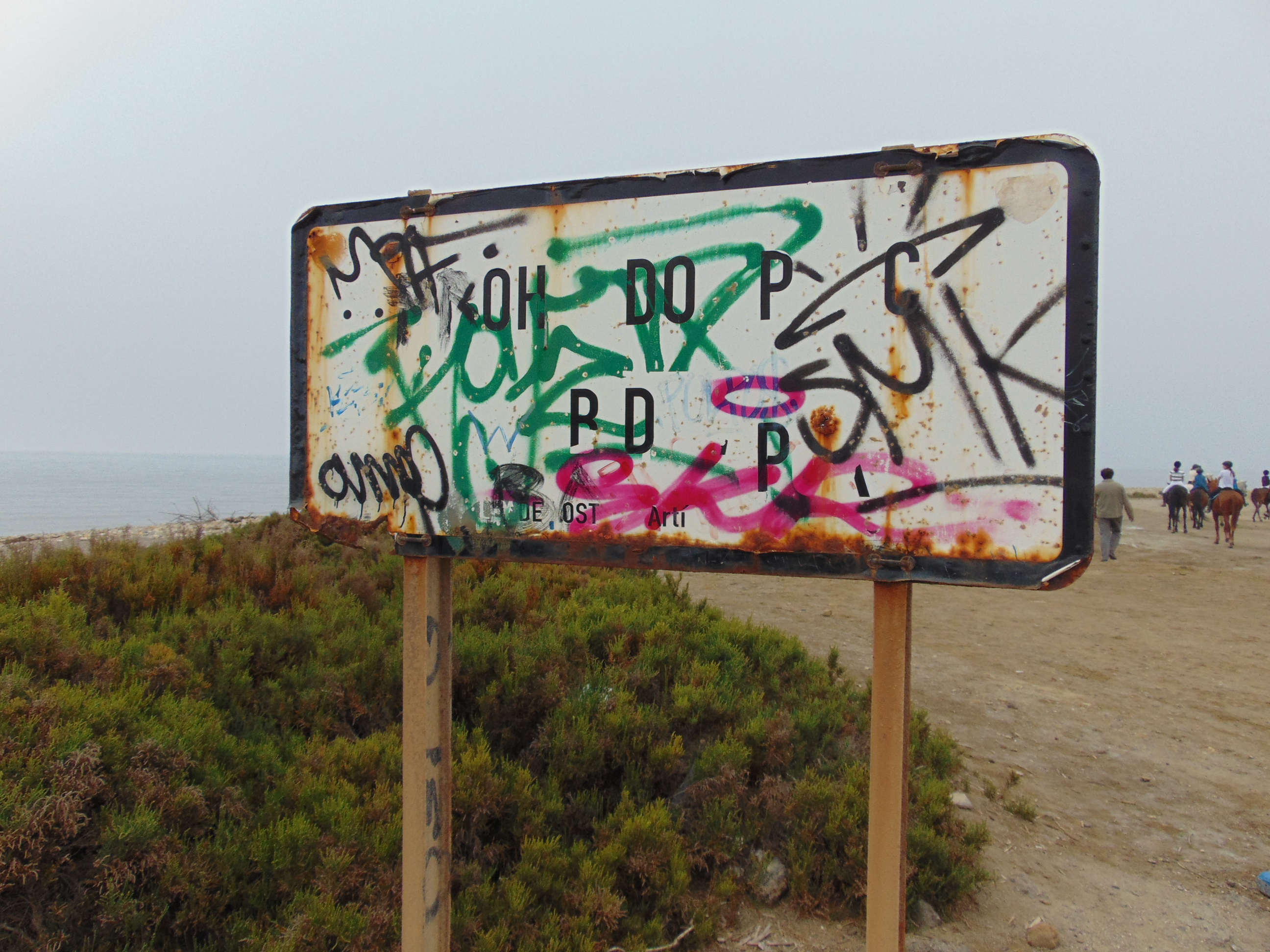
The other day, I took the dog down to one of those ‘unimproved’ beaches along the coast a way. It's along a dusty track on a cliff above some undisturbed coves. No metal benches, beach bars, life savers, peculiar white-painted cabins – with the inevitable ‘Goofy was here’ graffiti: no football or beach-ball courts, no playpens, swings or broken whirly-things, no flags, dustbins, informative signs in three languages, showers, accordionists, tulip-vendors or public lavatories. Just a few of those colourful motor-caravans as favoured by the wealthy trekkers from the far north that the police are now talking about fining after three days camping outside of the ‘approved areas’. Peaceful. I even anticipated seeing a few dolphins near the shore nodding and squeaking at us. They’re asking for fish really.

My dog seemed to be happy enough with the lack of clutter on that particular beach and ran about chasing pebbles and bits of flying seaweed (oops!). I took my socks off.

Things went well until I began to drive home with the window up to stop the cloud of sand and dust thrown by the wheels. The car stank of warm and wet hound and the thunderhead of dust, it turned out, upset a group of hiking Germans dressed in old-fashioned shorts who were coming the other way, intent on invading the next-door beach. Boy, did I get an earful.

On reflection, I should have been carrying a Blue Flag.


Future Imperfect


‘So what do we want the future of our town to be like?’ I asked the founding members of the latest version of our chamber of commerce. ‘We can have tee-shirt shops and bus loads of tourists, fancy hotels and convoys of BMWs or lots of satisfied residents living in peace and tranquillity’.

Behind me, a champion of the tee-shirt school of thought got to his feet. ‘We need more tourists and we need to bring them in through aggressive advertising and promotion,’ he said. Paid for, no doubt, by thee and me.

The occasion was a meeting in a local hotel. We were about thirty, divided as always in ex-pat Spain by the twin curses of monolinguality and self-interest. The local people consider that the town is for their exclusive use and that the visitors here (even those who are third generation) have as few rights and opportunities as possible.

Our town is beautiful. Or so they maintain. In point of fact, it's a modest settlement with simple buildings planted in an astonishing setting. The pueblo is a white cubist village with narrow walking streets adorning the top of a hill overlooking the sea since the dawn of time. It had almost disappeared, falling into rubble and abandonment, by the mid to late fifties and only the arrival of artists, followed by settlers from elsewhere during the following decade, allowed the village to re-group, and those of its citizens who had moved away to France, Germany or beyond, to consider returning. At least to sell off a few plots.

So it began. The older kids had inherited the agricultural lands – land where the water was no longer arriving. Many of them had left for better opportunities elsewhere. The second-born got the worthless beach-land, where no one lived, no one fished and, of course, no one went.

Now, years later, the greed has set in. The village overlooks seventeen kilometres of beach, strung out beside a narrow and poorly planned road with no possibility of widening it and equally no chance of building a parallel road to relieve the increasing traffic density. The tourist hotels don’t really work in the town’s benefit as their visitors aren’t going to walk very far along the thin coastal strip, and because the hotels themselves, having been forced to make cut-throat offers, don’t want their customers to leave the premises. If they are going to drink, by Golly, they’ll do it in our establishment here (by the way, there's a party tonight!).

Bad news for our eight hundred bars and restaurants.

Since builders make better money off apartments than they do houses, our town has built an endless number of small, ugly and, by necessity, cramped apartments that are inevitably only employed during the season (la temporada). Our eight hundred bars and restaurants mentioned above are therefore beholden to the year-long residents who either live in the reduced number of houses that the town possesses or, if they are in those small apartments – usually paying quite ferociously high rents - they probably can’t afford to go out anyway.

The best return on one’s buck for the builders (and the corrupt officials who sign them off), being apartments, then the worst return is parking spaces, roads and gardens. As far as the first two go, there are never enough parking spaces, which mean that there are never enough places for the customers to leave their cars (I have to spell it out here), which in turn means that the eight hundred bars and restaurants (many of whom also pay a cripplingly high rent) don’t get enough customers. I usually drive up to the pueblo for dinner; drive around looking for a space without success… and then motor on inland to the next town.

I’m sorry amigos, I was hungry.

The narrow roads, which kink and higgle n’ piggle around the different borders and narrow pavements, are usually too tight for two cars to pass, or one to park. Nice planning from the tee-shirt shop philosophers who, unfortunately, have run the town hall for the past thirty years.

Teddy bears, humorous ashtrays, wobbly pots, rag throw-rugs and vulgar tee-shirts: Louche shops selling tourist-tat.

Where are the theatres and the noble buildings? Why haven’t the wealthiest (and, trust me, they’re wealthy!) local families donated as much as a wooden bench to their community in all these years?

I turned to the chap who wanted busloads of tourists – one can only imagine that his interest was in his three-storey emporium – and asked him if his new shop (his old one had tragically burnt down last summer) would be a fraction less ugly than its predecessor. ‘Oh’, he said, ‘I don’t know, you’ll have to ask the architect’.

‘¡Ay Pobre Mojácar! La tratamos como una vieja puta. Todos queremos joderla mientras nadie quiere comprarla flores’: Poor Mojácar, we treat her like an old whore. All we wanna do is fuck her. No one wants to buy her flowers.

Here Come the Easter Bunnies

My favourite meme for La Semana Santa is the picture of some sunbathers in their swimming outfits somewhere on a Spanish beach and just beyond them, there’s a platoon of costaleros (float-bearers) bearing the heavy wooden base and statue of Jesus or sometimes a rather well-wrapped-up María as they trudge past on their way either to or from the iglesia. The sacred and the profane.

One should allow the faithful their pious week of devotion without unkind jokes, but as always these days, most of Easter Week is centred not around Jesus, but rather his opposite number, the Demon Lucre.

In the fancier cities (Seville being the obvious choice), the narrow balconies on some apartment buildings along the route where the processions pass are rented out by the afternoon to the prosperous for a veritable fortune, canapés and a bottle of wine included.

So sorry, there’s this rich group from Barcelona that have taken the balcony for the processions, maybe try us next year. Indeed, the tax people have already warned the apartment owners not to forget to declare their extra windfall.

Many places will have the streets full of visitors, frantically waving their mobile phones as the fellows in their cone-headed outfits (capirotes) march slowly past, to the sound of the municipal band playing the vaguely sacred music, or maybe there’s a gypsy singer performing a saeta. The larger processions will be sticking to the main avenues, where the 25€ seats are. OK, in Seville they cost rather more – anything between 70 and 160€. Apparently the cofradías (the guilds) share most of that between them, with a cut allotted for the people they have been obliged to hire to carry the saints (volunteers among the faithful being at an all-time low this season).

It’s a good time to dress up a bit. Maybe wear a shirt for once. Many of the women will be dressed with ruffles: and peinetas, fans in their hair.

This year there are more people than ever hoping to acquire a seat in the choicest area and ticket holders will soon be sat possessively upon them, upon a rented cushion.

Somebody is selling cold drinks and chucherías – assorted commercially-wrapped nibbles.

-’Scuse me, can you pass that down to the caballero?  

It’s the Easter school hols, with the kids out for a noisy week. Take ’em to the beach or the aqua-park, or maybe the parque de atracciones with the rides or the cowboys or the clowns. Wear them out, stick them in front of the telly and then go out for a decent evening meal.

Only, there’s a shortage of waiters to go around this year – it seems that we aren’t paying them enough and some places have even had to cut back on their tables.

The tourist departments have been busy posting adverts in all the media and are helping to fill the hotels to the brim. The regional government takes out a page every day in all the newspapers with institutional advertising (less of course the local foreign-language newspapers) to keep everybody on the message.

It’s the beginning of the season, and here in España, every tourist counts.  

Learning English

A local woman in the shop across from where I live put me down from the beginning as an Englishman. She's right, although I could be German or Swedish - as so many of us are. Anyway, English.

And to prove her point, she bursts out with her entire knowledge of the language in one remarkable salute when I heave up alongside.

Wotcher, she says.

I wonder where she picked up that particular greeting. Probably from a holiday visit to Torremolinos some time in the distant past. Or maybe she went to see a show at a music hall in the Old Kent Road.

Wotcher, orl the naybours cried,

ooh yer gonna meet Bill,

as yer walks the street Bill...

For those who need it, including perhaps my friend from over the way, there are a number of English-language schools in Almería ideal for brushing up one's idiom, including one with the odd name of 'The Mancunian Academy', which presumably teaches its students to speak the King's English with a flat Manchester twang.

A friend who hails from that city laughed when I told him about the school and said ... the poor things will all end up speaking Espancunian. Indeed!

A student I know in the Almería educational system is sixteen and he and his 120 classmates are currently using a book called 'The Skin I'm In' by a black American author called Sharon Flake. It's written in the vernacular: '...Then I had to fess up and tell her I forgot to do it. She asked Mr Pajolli if it's OK for me to use my office time to do my math homework. He said, yeah, but that I'd have to make up the time later. Teachers don't do nothing but cause you grief, I swear that's all they do.'

There used to be a Scotsman living in the nearby resort of Roquetas and who taught English. Can you imagine the sounds his more attentive students made? Another teacher I know comes from somewhere 'oop north'. I asked him precisely where a couple of times, but frankly, I couldn't understand what he said.

Over on the other side of the pond, as a Spanish journalist reporting on the USA tells us, more and more people over there are learning to speak Spanish.

Which, as I know from experience, they most certainly aren't.

First of all, it's not Spanish. As anyone can tell you, it's called 'Mexican' (Sorry amigos!) and secondly, no one wants to speak it much beyond 'andalay' which the American girls think means 'beat it'. Indeed they insist that all the Latins learn to speak English (or to be more precise, 'American'). The claim from the Spanish journalist is frankly about as likely as the British all suddenly deciding to learn to speak Urdu.

Back to teaching the Spanish to be able to communicate with us, so that they'll understand us when we want a full-English breakfast, just try and keep it simple.

Don't ask for kippers and remember that if they don't understand you, then shout!

My advice to the Spanish students is to watch movies on the TV in the original language, not dubbed into Spanish. There's a handy button on the remote. Read stuff in English - although maybe pass on Sharon Flake for the time being - stick to Agatha Christie, and even, I don't know, brave the Brit pub down on the Costa and ask for a pint.

But above all, try and shoot for good English. After all, if you are going to make the superhuman effort to learn a foreign language, you might as well get it right. A Spanish woman I once knew spoke fluent English which she had learned while living in the East-end of London. She came from a 'good family' too.

So here's the deal: Learn English from someone who speaks or writes it clearly, because the point is to be able to communicate to those English-speakers you will be meeting later on. Not all of them will speak it very well, so why not make it easy for them.

Are you wimme?

Good Food, Good Meat. Why Wait? Let's Eat!

I had two lunches yesterday. The first was an invitation to visit and eat with an Elderly British couple. We had fried turkey breast and a glass of white wine. Followed by an ice-cream on a stick. We talked about the weather (it's been a mixture of sunny and wet days this week).

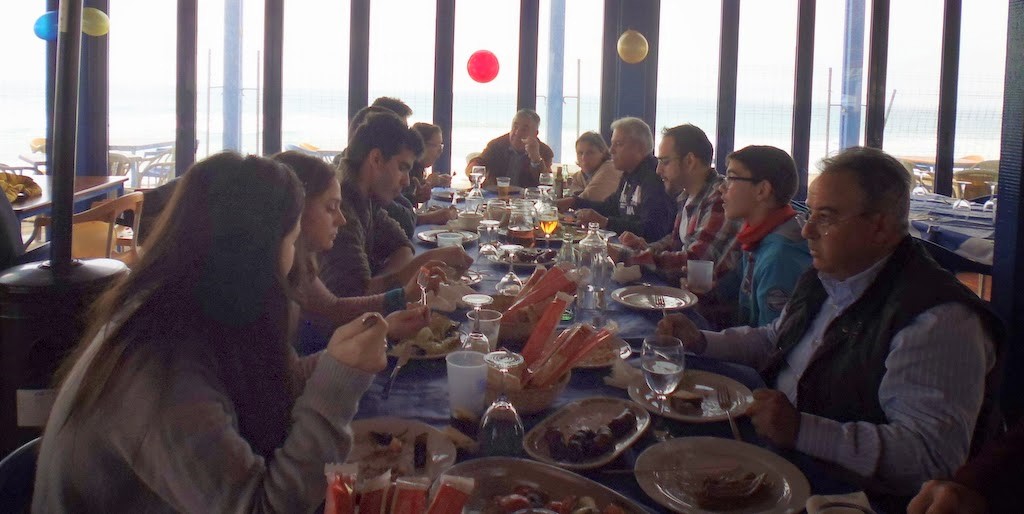
I then made my excuses and drove along the beach to a restaurant which is opening soon for the season. It was a Spanish friend's birthday and an enormous table for thirty or more had been laid. People came and went as more and more platters arrived from the kitchen. I was sat next to two local people I knew slightly, with a Danish couple seated opposite.

I discovered that the Danes had recently bought a house in the pueblo. I was going to trnslate something for them but discovered that they both spoke fluent Spanish. 'Oh, we learned it when we decided to move here', they said.

How very un-British of them, I thought.

My neighbour passed me endless pieces of meat, sausage, morcilla, alioli and salad. The man on my other side was more concerned about my glass. I had at least three drinks in front of me at one point (although, looking at the picture now, I seem to have been the only one). Pedro was running around telling everyone to eat and drink more, as his sister looked on approvingly. A cousin invited me to go hang-gliding over Easter and a young woman asked me about journalism, as she was studying both this and the English language, and was soon to leave for Malta.

The Spanish, of course, know how to eat and enjoy themselves.

I skipped dinner, by the way.

There's a thread on Facebook with British residents discussing local Mojácar restaurants, which is the best of them and so on. Very positive. There must be a hundred places, with local and foreign cuisine: Spanish, Basque, Madrileño, French, Brazilian, German, Greek, Mexican, Chinese, Thai, Indian, American, Italian, English, Irish and Argentinian.

The choices for best place, though, and seen through British eyes, seem odd. The cheapest and worst are mentioned regularly with enormous enthusiasm, while some will only eat in those family-owned place with ridiculously large menus. Menus where one has to take out one's specs ('glafas' as a bilingual friend calls them) and read with a glass of wine to hand.

Me, uh, I'll have what he's having.

Eating out should be a leisurely mixture of good food, good wine, good company and good service. You are paying for some entertainment and some theatre.

Skimp on these and - if it wasn't for the washing up - you might as well have stayed home.

Everything That's Runny Contains Water

I saw a billboard today while driving along the main road towards the playa on my way...