Saturday, 29 January 2022

Did Spain Get a Bit Tamer Over the Years, Or Is It Me?


The subject of old Renault 4s came up somewhere. My dad had bought one back in 1967 which stood us proud until one day some nitwit from Melilla creamed us on the way to the liquor store in Vera. I was in the front with my dad and suddenly, so was the dog and several empty crates of beer. 

It was a wonder that nothing was spilled. 

The Renault had a push-pull gear lever, as did its rival the 2CV. If you are not familiar with this, then know that there's a stalk sticking up out of the motor, the gear lever, and then there's an umbrella handle poking through the dashboard somewhere with a little ring on the other end which is loosely held over the gear-stalk. All you had to do was waggle it in the right way, a bit like those cranes that win a prize in the back of most bars. There was a trick to it. Reverse was way over to the right.

Or was it the left?

After that experience, my dad stuck to Citroëns. 

And beer from the supermarket in cans.

Life in Spain was fun. Franco had closed the gates to Gibraltar but otherwise left us in peace. Indeed, a trip down to the Rock to change money - it had the nearest Barclays Bank - involved a detour via Tangier, which was always a blast. Morocco meant - and still does - trips to the souk and a growing collection of carpets, trays, jalabahs and Goulimine beads. Gibraltar was English beer, sausage rolls and people with funny accents; but hey, you can find those anywhere these days, Brexit notwithstanding. 

My father and I spent a few days in clink in Vera once. We had been cleaning up the local view-points (by sawing down a select choice of billboards) and were thrown into the calabozo below the Vera town hall for our troubles. Greenpeace would have been proud of us. To our surprise, we were arrested several months after we had hung up our saws by a contrite pair of Guardias (my dad used to send a crate of wine over to the cuartel every Christmas with his compliments), but justice in Spain is rarely swift. We spent five days in the pokey before being released on bail. I announced that I was leaving school (I was attending one in Seville) as the consequent result of having become an old lag at 17. And thus I grew up. Franco returns to the story here, as he celebrated around about then his thirty five years of terror with an amnesty for small-time evil-doers like ourselves. 

Thus nothing more was said.

I went off after that and conquered society; well, the warm bits anyway. As an adult, I have spent most of my time in Spain (with periods living in the USA, Mexico, Paris, Florence and so on). In all, I have spent maybe three months in the UK since 1970 - probably more than enough.

Spain had filled up over the decades with us Brits - or rather, a reduced number of coastal villages did. There aren't many of us to be found inland, or in the cities. Locating an English breakfast or a Union Jack pub is hard to do where I live - a suburb of the provincial capital with an abandoned beach where there are no hotels, souvenir shops, Indian restaurants or even tourists. We have no currency exchange places or charity shops or even, for that matter, earnest dog and cat people. Each morning I manage perfectly well with a slice of tortilla and the local newspaper.

I can't complain. I spent plenty of my time as a young whippersnapper in the discos and knock-shops with the best of them.
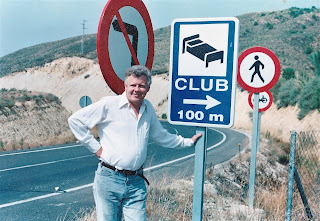
I smoked pot and still can't remember what I did when I was 27. I drove cars way to fast (I'm not counting my dad's Citroëns here) and was lucky in love. I travelled the world, or enough bits of it to catch a balanced viewpoint. I opened an expat newspaper here in Spain and ran it for fourteen years, which meant the end of my money.  I was married to a wonderful lady (she took this picture), who died in 2014; and above all, I read books. When we moved to Spain in 1966 - my parents, me and two whippets - we brought with us a half ton of books. 

These were not classics, or textbooks or anything of much value, but if there's one tradition that the Spanish will grimly stick with, it's broadcasting truly awful television. So I endlessly read novels. Indeed, as the years catch up, it's the one thing I can still do. And at the risk of contradicting myself - what a pity there's not a good charity shop handy! The nearest one - six books for a euro - is an hour down the road from me.

Friday, 28 January 2022

The Cold Cut

 I was in Pamplona last summer when I was suddenly taken short by an urge for a haircut. You know how it is – by this time of life, you are not too keen on being wrapped in a sheet and seated in front of a huge mirror for twenty minutes contemplating your fallen chin while a flunky clips away at your head, but, on the other hand, you’ve just broken (or mislaid) your comb.

The somewhat gabby hairdresser lady established that I was a tourist, had once ‘run the bulls’ (madness!), loved to eat fish cooked in a local sauce (al pil pil) and pointed out that there was nothing like a trip to the ‘pelu’, the hairdresser, to pass some time. She motioned to Brad Pitt on the wall behind her and we agreed that, yes, I’d like to look exactly like him.

I had a ‘Number Three’. An electric clipper thing with a bit extra on the top (in case a future barber or member of Brad Pitt’s family reads this).

There’s a hairdresser down where I live who seems OK. She looks like Lisa Minelli. She runs a shop just downstairs from the office. I sometimes belch, break wind, sneeze, hoot or yap as I pass her place on my way somewhere: the blessings of age. It’s nothing personal, it’s just that she's next door to a popular bar. On the other side of the bar, there's a lawyer, and everyone knows it's bad luck to cross a lawyer.

Thus, I always turn left after the morning libation. Sometimes I inadvertently surprise her as I groan from a cold beer or snort from some minor blockage caused by a shrimp. It has occurred to me to be embarrassed by these small yet regular dramas, but I reckon it’s her move first.

Ms Minelli had once cut my hair, in the days before I knew about choosing a number for my grooming pleasure – now that I come to think of it, a useful convenience similar to dining at the Chinese (Numbah Seventeen - and easy on the MSG).

Normally though, I go over the way to this gloomy fellow called Pedro. For a start, he doesn't have a mirror. The idea will come to me (must cut hair) as I pass his shop and, if it’s empty and Pedro is seated in his antique chair and conspicuously immersed in his newspaper, I’ll go in.

Número tres I told him today. Easy on the top.

Walking back to the office, surrounded by flies attracted, I suspect, by the hair-gel that Pedro has slapped onto my head, I was visited by a violent sneeze. The kind that shrieks. Yaaahhh!

Just at that moment, as a bullet of snot ricocheted across the empty walkway, I saw a startled looking Lisa Minelli having a smoke on the terrace. I’m not sure, but I don’t think that she was very impressed.

Monday, 24 January 2022

A Small Trip in Time (Well, about ten years ago)


El Oasys Parque temático del Desierto de Tabernas


I’ve got this new car. I say ‘new’ in the sense that I have recently acquired it rather than ‘brand new’ as with heated seats, airbags and a television on the dashboard. It’s a huge old white Mercedes diesel that takes several minutes to get up to speed, a bit like a boat. I imagine howling down a speaking tube to the engineers down below ‘full speed ahead – there’s a straight bit coming!’…

The other day I steered it to Mini Hollywood past Tabernas to see the recent additions to the zoo there.
The zoo is a generous 25 hectares of cages, runs and paddocks which backs onto the Mini Hollywood cowboy town, knees-up can can show and hangman’s rope. All coming highly recommended by this reporter.

We (there were three of us in my party) were met at the gate by the company biologist. I entertained him with my plans to seed the surrounding hills with wallabies to encourage tourism. You should try saying ‘wallaby’ in Spanish, by the way. He seemed a little out of his depth as I droned on about the empty space and lack of biodiversity. ‘But there’s over eighty autochthonous species in the park,’ he argued. Boring ones, I pointed out.

We passed through the gates and allowed an eager photographer to take my likeness in a cowboy hat and pistola (picture ready at exit) and carried on through the intriguing looking cowboy film-set cum Clint Eastwood memorial park, past a very surprised looking ornamental Indian wedged in a window and into the zoological garden, called the Oasys.

We had been invited to see the improvements on the reptile house, which is a large single-storey building with snakes, lizards, terrapins and crocs in large and well-decorated tanks (with no smells), good lighting, interesting displays and surprisingly frisky inmates. The hall appears to be the work of Dr Herman Schleich, a herpetologist, explorer and writer. He has spent many years in such odd places as Cabo Verde and Nepal and now lives in Tabernas, no doubt with a pet chameleon clinging to his shoulder when at home. He has done a fine job of the display.

We moved on to larger things, including a superb and dramatic stadium full of tigers. A guide holding a crib-sheet followed us around: she confessed to me that she preferred cats to snakes. We continued past marmosets, parrots, porcupines, prairie dogs, past the bar-restaurant, past the macaws, duck, pheasant, lynx and panther to another new enclosure, where the bears live.

The park is massive and the backdrop to the whole thing is, of course, the Tabernas desert. The whole effect is most dramatic.

Waiting beside the bear-pens and the deep valley below them was a train-wagon waiting to take us slowly off to the larger animals, including two lumbering hippos, a clutch of camels (of both persuasions), some wolves and a variety of deer who looked, on the whole, pleased to be behind a different fence. They have secretary birds and buffalo. Giraffe and wildebeest.

As we chugged slowly past (is that the best word for something that runs on electric? Chugged?), the clouds came to a rare decision and it began to rain, which is always an agreeable yet novel phenomenon in the desert. The hippos looked faintly pleased and the giraffe tutted and went inside.

We continued on foot back towards the spiritual centre of the zoo (I think I had already mentioned the bar?) and helped ourselves to some refreshments. A magnificent male peacock watched from a nearby wall.

From here, we repaired to the snake-shed for another look (via the bat-cave and a room devoted to animals tracks). I noticed on this second visit that there was a model head of a Tyrannosaurus Rex (I’m generally quite observant that way) and a collection of fossilised lizards, crocodile and froggy toys, African and Asian denizens of the forest and desert floor rendered in wood, and several books on show from the pen of the Good Doktor Schleich.

The rain had stopped and we had been in the park for several hours. A bit wet but thoroughly satisfied. It was time to leave. The way out of the zoo takes you past a huge and little-visited cactus garden with perhaps as many as two hundred and fifty varieties collected from all over the warmer bits of the world. Some are in flower now, producing blooms which are rarely seen.

From here, you are in the alley behind the cowboy town of El Fraile, which you will suffer a strong sense of déjà vu.

As far as I know, and the museum of posters and projectors will back me up here, if it wasn’t shot in Tabernas, it wasn’t a spaghetti western. The museum, we’ve crossed the main plaza by now (without getting shot at by some loitering desperadoes) is crammed with posters of The Greats. I shall mention my own favourites here (sorry, Clint): Anthony Steffen, Giuliano Gemma, Lee Van Cleef, Bud Spenser and Terence Hill.

Marvellous, and, with the exception of Van Cleef, all Italians. Music from the greatest Italian composer of them all, Ennio Morricone, echoes from gigantic speakers disguised in the roof; that dramatic piece with the single chord - just as it did in a Fistful of Dollars: dum di di dum di… dum di di dum. People are outside in the plaza, gathering…

And then the Hero, upon being given a four-barrelled shotgun in The Stranger Returns, quips, "Old man, there'll be hell raised in the village tonight".


El Oasys is just to the west of Tabernas. Coming from Vera, take the motorway towards Almería and turn off towards Sorbas. Taberenas is the next town (the old N430 to Almería) and the park, still remembered as ‘Mini Hollywood’, is on the right, a few kilometres past Tabernas.

Tuesday, 11 January 2022

Something Different


It must be getting harder to come up with a new cuisine around here. We are spoilt for choice. We have Spanish restaurants, British, French, Arab, Chinese, Indian, Italian, Mexican, Argentinean, Columbian and Thai restaurants. We have German. There are a number of Dutch places. We have nouvelle, hunt and fish restaurants. Beach-bar grub. Pizzas and burgers. There’s a Donner Kebab. Sometimes the menus are lovingly translated into Spanish even if the staff don't speak a word of it. Hey, you can always point.

We shall sooner or later even have both the Colonel and Ronald Macdonald, lucky us, probably situated in one or another of the increasing number of empty banks (with bullet-proof windows). We have tapa bars and bocaterias (submarine sandwiches). You can dine on Tex-mex or munch on paella. There’s still room here, I grant you, for both a Greek and a Suchi restaurant. In fact, and here’s a suggestion, you could even combine the two.

Not bad. In the old days, we just had chicken knuckles, lamb lumps, crotch-meat and sardine-heads. All that at fifty cents per customer with a bottle of wine thrown in for good measure.

Sometimes even a full one.

I was thinking that there is space here, however, for a really good off-world diner. Besides Dibbler’s rat-on-a-stick and the Restaurant at the End of the Universe, it’s a hard fact that the world is remarkably thin on decent alien eateries.
I imagine being served something colourful ('tastes like chicken') by a waiter with an over-indulgence of fingers. Perhaps a decanter of ('tastes like wine') darfle-grog. Do you see where I'm going with this? Pictures of the Planet Clunk would decorate the walls while squirty-music played sofly.

Perhaps my friends would come and throw bits of clump at each other.

So, it’s just a suggestion, but it could play well to the gallery, don’t you think?

Good Lord no. I haven’t had a drink all day.

Not even a darfle-grog.

A Morning Bracer Sets One Up for the Day

 I won't say that I started the year with a glass of tequila, mainly because I was in bed by half-past nine. Age takes its toll. Breakfast will come around in due course, and maybe I'll have a rare Bloody Mary to set me up instead of my usual glass of warm goat's milk. 

The more seasoned workers out here in the Spanish shires like to start their day with a bracer, to help them get going until the whistle goes for their merienda, sometime around eleven. Now a morning nip in Spain could mean a brandy or an anís (or indeed a fiery mixture of the two called a sol y sombra) but taking that as a regular morning wake-up will eventually rot your liver with the consequence that your retirement years chewing a pizzle-stick while looking tolerably wise will be all the shorter. 

The answer (if you are a drinker, that is) would be to  pour some hot black coffee over the hootch - hey presto: ¡un carajillo! Whether it's un brandy (we aren't allowed to say 'coñac' any more) or something from the cut-glass aniseed bottle with a picture of a monkey on it. 

Of course, the unconventional will order something less known, maybe a ponche (a late friend of mine thought it was the the fountain of youth and would switch to it, he said, when the brandy was paining him). Ponche, it comes in a silvered bottle, is pretty good stuff. It's a sort of sweet-orange syrupy little number. 

Huh, I just got corrected by Google (or, in this case, Gargle) who says  'The genuine Spanish ponche is made with five top-quality natural products that come from different parts of the planet: the skin of the best Andalusian oranges, cinnamon collected in Sri Lanka, vanilla from Mexico, cloves from Madagascar and nutmeg from the Moluccas Islands'. Geez, it certainly makes Sloe Gin look a bit foolish.

Yesterday, I was in the local bar having my morning half a toasted pan de hoy soaked with tomato and olive oil ('un medio con tomate') and a coffee, when the fellow next to me surprised me with his order. It was a glass half-filled with crema de menta, topped up with warm milk and a spoonful of sugar. After he had tottered out back into the inclemence of the January sunshine, I asked the old girl behind the bar whether she sold many of those. She said, that no, but that he was a retired Guardia Civil, and he evidently liked the colour. 

There's a popular kiosk in downtown Almería, near where I live, which serves a breakfast drink called un americano. This rare beverage is a leche manchada - a milky-white coffee - with a shot of dyed Licor de Kola (a strange Valencian alcohol based on the African kola-nut which is said to be brewed by the true inventors of Coca Cola). Served with a twist of lemon, some vegetable dye and a sprinkle of cinnamon. The bad news is that the kiosk has been bought by a teetotal Saudi who is planning on trimming the morning menu, leaving any ambitious Almerían cafetero with an interesting opportunity. 

For those who won't go with coffee, but want to keep their drinking civilized, one could not do better than to emulate my friend Manolo, who always takes un tewe - a tea with whisky.  If he were Scottish, I suppose he'd be pouring it into his porridge. Hell, I personally don't say no to a tot of Cap'n Jack poured on my ice-cream.  

And so, we return by a roundabout route to the Bloody Mary. The secret of which, and don't tell anyone I told you, is a surreptitious squirt of dry sherry into the shaker. 

Thus the day takes of a joyous and propitious view, whether it's to work, relax, write, or recall criminals apprehended or otherwise. A simple libation before the serious business of surviving until the cocktail hour. 

Content

Here we are with a fine opportunity to write about Spain, and well done to the bloggers who usually stick to this fascinating subject. The truth is, for we foreigners (expats or immigrants - but that's for another day), we can never learn enough about this marvelous country. There will always be references in everyday conversation we shall miss - unless you had the good fortune to be raised here as a child.

In that case though, your reading will probably be in Spanish - as (y volvemos a lo mismo) their writers will be better informed. Their newspapers are better, too.

But, sometimes we foreigners, with some (or no) experience, decide to start up a newspaper or a magazine, together with some bloke who is going to wander around the bars and sell advertising, another chap with an old van who says he knows the area well and will deliver, a young whizz-kid for the layout on the computer (in my day, it was cut and paste) and a printer that we found - God knows how - up in Ciudad Real who won’t charge too much.

Between the adverts in the mag, we are going to have spaces, which will need filling. We are going to need a writer.

Now, the given. We are in Spain; we are continually learning about this country and we are all, readers and publisher alike, part of the same great adventure. We shall learn together about the geography, politics, language, literature, art, gastronomy, history, flora and fauna, films, music and folklore. What a fabulous opportunity!

But our readers are, apparently, unadventurous, and thus, let’s print articles about lipstick. Articles about the North American fox, about Coronation Street, the First World War, Red China, Marks and Spencer, Manchester, fajitas, Iraq and facelifts; maybe some brainless quizes, rants about Muslims in the British 'homeland' and the price of strawberries in Oxford.

There’s a splendid opportunity to write about sports (if such a thing grabs you), about the victory of the Spanish basketball team, the Spanish Grand Prix champion, our cycling and of course, our football. But no, with the exception of the odd incoherency about or from David Beckham, we will treat you to articles about Fulham or Arsenal.

To remind you further that we are now living in Spain – presumably at our own free will – we will offer you the week’s or even month’s television entertainment. The 'full TV satellite guide' from Britain. Good Lord, it's snowing in Birmingham.

With rare exceptions, the items we shall reproduce for your reading pleasure will appear unsigned. Yet, some poor joe wrote (or translated) them. Writers usually get tuppence for their efforts anyway, but they do like to see their name in print.

When one of our local newspapers prints some piece – apparently to fit some hole on page nineteen next to the advert about cesspit repairs (seventeen years experience, man and boy) – as often as not, there will be no credit for the writer.

Much of the material which appears in our local newspapers and magazines if not about Spain will probably have one thing in common, one general point of union. The articles will come from the Internet.

You can imagine.

‘Geoff, I’ve got a hole on page 32’.

‘Don’t worry, Alice, I’ve found a bit on the Pyramids’.

Another kind of scrip will sometimes float around in a newspaper. Sometimes it will be labelled ‘advertising feature’ and sometimes not. It will be an article handed in by an advertiser with, let’s say ‘not entirely impartial recommendations’ regarding building, eating, investing, shopping, funerals (ahem!) and buying a second hand car. Since these ‘puffs’ are invariably set in Spain, the reader might fall upon them with more enthusiasm and unalloyed relief than they in fact merit.

I like good writers. I think that they make a newspaper worth picking up. I think they entertain and educate the reader.

I think a good writer is worth paying something. I think it’s an opportunity worth taking. 

Forget plagiarism, cynical and bad editing and gratuitous puff pieces. Ask to read something decent about Spain.

Gimme a Glass of Milk (inna Dirty Glass)

 Spain has always had an interest in milk, even if, until recently, you couldn’t find a cold glass of it anywhere. 

The old milk was a definite bluish colour and came in a 1.5l glass bottle with a narrow top and a metal cramp, like a coke bottle. This stuff could sit in the sun for weeks without losing its taste and often did. Apparently, to help it last, they took the cream out of the milk and added a shot of pig fat. The blue colour came, apocryphally, from the formaldehyde that kept the mixture quiet. This explains why breakfast cereals came to Spain rather late. Pour that broth over your Frosties, it would have eaten them before you could.

Later UHT milks from different companies, now mostly in the handy tetrabrik box, became acceptable for coffees and so on. A cup of (proper) tea would be flustered by this stuff, but you can get used to anything. Now, we even have sippin’ milk in the supermarkets. Tastes good.

While milk has never been considered a serious drink (despite the best efforts of some of the producers to tell us different in the usual kids adverts), it has certainly spawned a whole slew of versions. We have milk with vitamins, milk with calcium, skimmed milk, partially skimmed milk, milk with royal jelly, milk with acidophilus (a handy bacteria apparently found in drool), specially flavoured chocolate, vanilla and strawberry milks, rice milk, soya veggy milk and even the ubiquitous goat's milk (which I still haven't tried). In point of fact, I doubt if many of them ever loitered under a cow. Certainly our pet calf, Petit Suisse, refused point blank back in her heyday to drink one particular brand, the Valencian-produced ‘Leche Ram’. I see the company has since gone pear-shaped. Perhaps the calf knew something.
There's a thing that looks like milk but isn't - the exotic Valencian horchata made out of a tuber called chufa, or tiger nut. Obscure maybe, but served cold it hits the spot. It is also one of those rare drinks that can't be mixed with booze, no. While warm milk will take kindly to brandy, horchata is decidedly abstemious.

At the same time, yoghurt has done just fine. I think I first tried yoghurts here in Spain as a child. The Danone people (a company from Barcelona), were putting out their early flavours by the time I first arrived here in 1966 (they actually started in 1919, selling the stuff in farmacias) and apart from the plain one (add jam and sugar), there was at least a strawberry one going strong. How long they might have lasted outside a fridge is probably best not to think about.

These days, there are an untold number of flavours clogging up the nation’s cold-shelves, with anything that grew on a tree or a stalk being processed into a yoghurt cup (although, if you look closely, most of them won't have the word 'yogur' written on the lid).

For the purists like me, one can even get ‘Greek yoghurt’ (thicker than the usual stuff). I had a summer job in Crete when I was seventeen and took a permanent liking with anything to do with the island, from Katzanzakis to Backgammon. Spain is not, with the notable exception of the oddly-named Oikos, very kind to Greece (try and find a Greek restaurant, a pair of gentleman's crapcatchers or a bottle of ouzo).

Together with the yoghurt, another milk-based little number on the shelves is guajada, a set rennet made from sheep’s milk. It comes in a little stone pot. With a squirt of honey, it’s pretty good.

Where Spain triumphs is with its ice creams. The main area for ‘artesanal’ ices is the interior of Alicante and Valencia provinces, notably Jijona (also famous for its nougat). Heladerías cover the main streets and offer dozens of alternatives. They (thank goodness) are all licenced, so you can put a shot of whisky on top of your tart. In fact, tarta al guisgüi (as the purists would spell it) is one of the best and most august of Spain’s postres, together with the ice-cream bar with two or three flavours (vanilla, strawberry and chocolate), natillas (a custardy thing) and the ubiquitous flan, the crème caramel. Then, there’s leche frita, or ‘fried milk’ – it comes in caramel covered chewy lumps – to try as well (probably just the once).

Before the fridge came along, and those fat blue bottles of Puleva ‘milk’ were still being used for arcane cooking reasons, Spaniards would often put condensed milk (which I think came from Holland) in their coffee. They still do, and as a ‘bonbón’, your morning coffee will give you a good kick-start.


Everything That's Runny Contains Water

I saw a billboard today while driving along the main road towards the playa on my way...