Saturday, 27 May 2023

Under Plastic

 I live in an area surrounded by greenhouses.

Plastic ones.

In Almería, and perhaps only counting those invernaderos which cover the dry earth from El Ejido and Dalías east towards Almería City and La Cañada, there are said to be 36,000 hectares of crops growing under plastic. There are more west towards Adra, with the provincial frontier with a small bit of coastal Granada, and on the northern side of Almería; more still around the curiously-named town of Campohermoso (plastic farms are most certainly not hermosos - that's to say: beautiful) located in the campo de Níjar and, back on the coast, as close as they can manage to install them around the attractive natural park of the Cabo de Gata.

An article in the Spanish press calls Almería 'the Orchard of Europe'. It may be thinking more of the olive trees out towards Tabernas and Sorbas, or maybe the lemon tree I've got planted in my garden (you can see it from the street), but our main contribution to the supermarkets of Europe (and even those of the UK when Almería isn't heavily snowed in - at least according to the Daily Express), are the plastic farms, where we grow tomatoes, peppers, cucumbers and melons (and, er, marijuana too). 

The number of hectares under plastic in the province hasn't changed in twenty years, which seems unlikely, since new ones are always going up, but there you go. 

View from somewhere above El Ejido taken last week


The plastic farms are raised on land which is pretty infertile: blasted by the sun and bone-dry. Back in 1960 (lots of photos here), someone figured out that covering the plot with plastic and bringing in the water - generally from underground aquifers, would encourage the plants to grow faster and stronger. It gets very hot inside the invernaderos, and frankly a bit hard to breathe on the days that one sprays with weed-killer or pesticide, but the profits are good, and the workers don't seem to have anything much to say about the conditions. 

This is because most of them are either 'undocumented' or registered as migrant workers. Many live in wretched conditions (El Walili, a long-term bidonville in Nijar, was abruptly torched and bulldozed flat recently. It had some 500 residents who were obliged to scatter). Around 98% of the workers in these farms are foreigners says the local union, a number somewhere between forty and fifty thousand, and of course they don't have many rights, and certainly not The Vote (needless to say, the racist Vox party does well in the agricultural sector). A further 30,000 (generally Spanish or at least European), work in the packaging plants or as truckers hauling the produce north. 

An article in Público runs details about the labour inspections in the invernaderos and the difficulties of the inspectors in finding who, where and what. According to this, in the last five years, some 11,000 workers have been found to be improperly employed, and the inspectors have handed down around fourteen million euros in fines. Agrodiario on the other hand says that the field-workers are all legal and well paid.

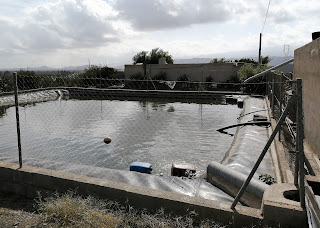
The plastic eventually perishes, and is either lovingly collected and sent to a proper recycling plant, or more likely, discarded in one way or another. An article on Google claims that around 80% of all used plastic ends up either as landfill or simply junked, and another 12% is burned (often in 'accidental' fires). An article at Wiki claims that around 30,000 tons of plastic waste is produced annually. On the bright side, a study by the University of Almería claims that the giant immensity of the plastic actually reduces global warmth - at least locally - by reflecting the sun's heat back into space. 

One of the smaller support industries belongs to the bee-breeders. They produce small hives of a few dozen bumble-bees which are then installed within the plastic farms and employed to fertilize the plants. I sometimes find a stray one coming to inspect my lemon tree (they sting like the very devil).

Almería was always a poor and forgotten part of Spain. Now, with its gigantic industry of plastic farms, producing in 2022 a massive 2,787 million euros in sales, it's certainly odd that Vícar and Níjar are the two poorest municipalities in the entire country.

Paperwork


We have all laughed, or shuddered anyway, at the mention of Spanish paperwork. What happens is that a veritable legion of functionaries (now, there's a word) spend their entire adult lives - it's a protected job in Spain - filling out forms.

The forms will be in triplicate, need additional supporting documents (which, in turn, will need other bits of paper) and so on.

We used to have to drive into The City, now and again, to hand in, collect, or refile various formularios for sundry purposes. I remember that one would often need a poliza, a twenty-five peseta stamp, to add to the document. These useful and decorative items would be sold in an estanco, a cigarette shop. The nearest one to the Government office invariably being half a mile away. A bit like - and maybe you have noticed - the nearest pharmacy to the hospital or medical centre is invariably located on the other side of town.

Anyway, walking calms the soul (or maybe the sole: I shall have to look it up).

My father-in-law used to be pleased if he got one or more of his three bits of paper stamped or archived as appropriate on his rare trips to Officialdom. He claimed that it brought an interesting sense of drama to his otherwise quiet existence.

We often used - and indeed we still do - the services of a gestoría, an office whose single purpose is to help you get through the various jumps which an immense army of bureaucrats must create to justify their existence. For a modest sum, the gestor will sort you out splendidly - and may, if he has other business to take care of, even accompany you to see the pen-pusher in question.

They all know each other, naturally enough - 'Hola Paco, I've got another one here, he says he wants to import a fire engine'. 'You'll need to fill out this form, and that one and bring along those two from industria, and a P834 from the police. How's your uncle doing, has he had his gall-bladder removed yet?'

You can see why you need a gestor. Buy him a drink afterwards.

Getting a residencia in the old and dark days of the Late Sixties would often revolve around a small gratuity to the nice policeman at the jefatura. I remember being deeply impressed as our gestor swept around the cop's desk and deposited a plastic bag containing a carton of Marlboro and a bottle of Johnny Walker next to the officer's lower extremities.

Everything went smoothly after that.

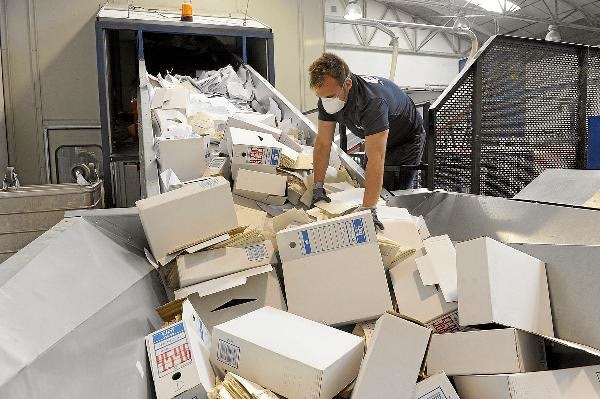
But, as legions of people pass in front of the armies of bureaucrats, the paperwork begins to mount up. Not just the shelves and the cupboards but the tables and chairs and even the floor are eventually full of piled up documents, and archives, and cardboard folders crammed with photocopies, and binders with abandoned forms and memos, and packets with double-spaced applications and folios in triplicate, bristling with staples and paper clips and Post-its and perhaps even some sealing wax...

and as Sarah Cynthia Sylvia Stout eventually discovered...

The garbage rolled on down the hall,
It raised the roof, it broke the wall...

When such a moment arrives, the chief pen-pusher will call upstairs to the junior political appointee, impatient to be noticed and moved to higher office, perhaps in the motor division, and inform him of the problem. Maybe fill out a few forms just for the appearence of the thing.

It is now that we meet a new department, the Junta de Expurgo. Their job is haul all the paperwork away, under supervision from a magistrate since it could be sensitive - this is when they might find that empty carton of Marlboro for instance - and to go through it in search of those treasures which must be saved for future researchers as patrimonio histórico.  The rest of it is then destroyed in a special oven along with those inflamable things confiscated by the cops such as - well, perhaps it's better not to ask.

And then, the whole wonderful process begins anew.

Gentlemen

While Spain has made leaps and bounds in almost every sphere, public lavatories still need some way to go. We may no longer be in the field of the early travel guide which recommended in the brief section under 'Conveniences' to 'where possible, best start your own', but there are still a few problems that need ironing out.

Being a fastidious and modern country, ruled by all sorts of obscure interests - often of a commercial leaning - we must now expect wheelchair-accessible toilets, even if the building in question has a stairway to get to it. Perhaps, you see, you broke your leg after you gained the bar.

Probably tripped over the step.

Some lavvies don't have a seat, for a reason which I shall shortly be examining, and customers, certain customers, may no doubt be obliged to fastidiously hover over the pan. Which is hard on the thigh muscles. At least these thrones will flush in an orderly way as a rule.

Many years ago, my mother pulled the chain of a local dunny and the whole tank fell off the wall and on to her head. The rest of us standing around the bar were left speechless as she returned, drenched, from the servicio. I believe I learned several words I hadn't come across until then. 

Worse still, there are those latrines that don't rinse, and haven't for some time. The lever has disappeared, or maybe it rusted. You probably won't find them in your local bar, but if you find yourself caught short in the wrong neighbourhood, you'll see that, O Lordy, they exist.

One horrid sort of privy is the old-fashioned squatter, which is a kind of perforated porcelain base with two raised bits for your feet, pointing either one way or indeed the other according to the nature of one's purpose.

On the bright side, the days of being invited to put the used paper in a handy nearby basket have more or less passed.

Pissoirs, those elegant against the wall systems, are odd. They are often fixed to the wall in an elevated position, too high for the shorter gentleman. Oddly, in the USA, this tendency is reversed, with the urinal apparently installed for those of a smaller stature. Our local hotel favours these plumbing fixtures in a basement setting, which is fine, only the automatic light tends to go out after a brief time, which can be annoying if one is day-dreaming.

New Spanish bogs have lower and close-to-the-porcelain tanks, so a collapsing reservoir rarely happens anymore, even if the flow in the modern variant is somewhat reduced. They have a small and large flush to save water. Which may explain why customers sometimes feel that their brief visit to the WC is rather second-hand.

Indeed, I once stayed in a very smart hotel in Melilla and, on removing the wrapper on the crapper and lifting the lid, found a large turd in the bowl.

They had a chocolate on the pillow, too.

Talking of low tanks, many modern privies have a pan so close to the flusher than the seat won't stay vertical for the discerning gentlemen. It's hard and unnatural to try and hold the seat up while taking a whizz, so the usual thing is to not bother, and merely piss all over the commode, seat included. Using one foot to hold it up doesn't work either unless you have a good sense of balance and, besides, are seriously well-endowed.

'Yes, I've finished, go ahead' you mutter to the next person as you make your escape.

Maybe as many as a quarter of all public johns have this unfortunate design-flaw, at least around where I live.

One small step better, other thrones have a seat which appears to be steady when lifted to the vertical, but will suddenly fall from the position with a mighty crash. If that doesn't make you jerk mid-stream, nothing will.

It's all because the tank is to close to the khazi, for goodness sake. I can't imagine who designs these things, the potty company or the installers.

It's as if the Nation's fontaneros all sit down to pee - or maybe they have a secret code of humour... 

But Hush!, the Secretary has just informed the President of the Worshipful Guild of Plumbers that he may rise at his convenience and deliver his speech to the congegration. Apart for his tendency to tell fart jokes, one can be sure how he will begin:

'Ladies and Gents...'


Franco Remains Dead (Despite What We Hear)


 I was a handsome young fellow in those days, un señorito if I say so myself. I was living in Mojácar in a society of older and generally rather drunken Europeans and a sprinkling of Spaniards who treated us, in those days, with a mixture of gratitude and respect, as we learned a few words of Spanish, built unimaginably large houses and drove astonishing cars (usually with the steering wheel in a novel place on the dashboard) and sometimes bought them a drink in the bar in the village square - the Hotel Indalo run by Antonio. Toma una copa conmigo, my dad would say.

Some of those cars would fall off the cliff as we drove home, sometimes with tragic results, but we were left alone by the police - we were bringing wealth to the village and it was sorely needed. Jacinto, the old mayor, his job awarded to him by the provincial governor, was careful to see that we were happy and that no one watered down the gin.

They were idylic times.

Franco, we said, if the subject came up, he's a good old thing - keeps the place safe. And it was true enough. The Guardia Civil were feared and when it came to it they were, let's say, suitably 'trigger happy'. Things were quiet enough in our small, forgotten, ignored and peaceful corner of a province that, during the Civil War, had been fiercely supportive of the Republicans. Every village had its stories of murder and executions: it had been a terrible time, now carefully put to the side and forgotten.

The Swedes up in Jávea went rather further than we did, organising one day a big (and approved) rally in the bull-ring, with home-made banners reading 'Arriba España' and 'Up Franco' (they meant well). But we were quiet enough - never talk about politics or religion was our motto. Antonio, un brandy por favor.

Then came word that the Old Boy was failing. He was put on life support in the Ruber Clinic in Madrid and lay in and out of a coma for several weeks as the world anxiously sucked its teeth and wondered what would happen next. The once and future king Juan Carlos was waiting with the rest of us.

Saturday Night Live in New York famously began its regular news-segment with the story that 'The Caudillo of Spain, Francisco Franco, is still dead'.

It's said that the crowds oputside the clinic would enthusiasticaly shout 'Adiós, adiós' and that the stricken dictator would ask a fawning courtier, 'what are they saying?' 'Goodbye, goodbye', said the lackey. 'Why, where are they all going?'

And then, finally, he went. On November 20th 1975, the Generalísimo breathed his last and Spain went into heavy mourning. Everything was closed down and quiet.

The small group of emigrés that lived in and around Mojácar naturally felt sorry for their kind hosts and thought that the best thing to do would be to show up at the iglesia for the mass to celebrate the soul of the murderous old sod. We trooped in to the church, dressed in shirts and ties (those of us who owned such things) and were faintly surprised to see that, apart from a couple of old girls dressed in that kind of black you don't normally see these days, and a startled-looking priest, there was nobody at all. The cura gamely got on with his pater nosters and we stood or sat, as required, while trying to look as sorrowful as we could. What will they do without the old swine? we wondered.

At last the service creaked to an end. We passed through the door of the church into the somber evening outside, where a large and evidently indignant group of Mojaquero males were waiting for us. A threanening pause. Then Alcalde Jacinto suddenly broke the hostile silence with exactly the best thing to say:

'Antonio, go and open up the bar, the extranjeros are thirsty'. With a groan of relief, we all scampered off around the corner to the Hotel Indalo for a welcome libation.
...
I found the newspaper featured at the top of this story while cleaning out a box of junk this morning.

Mojácar, 2073

 Archaeologists have begun work on a new dig to discover precisely what lies under the town of Disneyville in southern Spain.

It is known that the settlement under the garish collection of today's souvenir stands and disco-pubs was once called Mojácar, but there is little left to guide the investigators into an idea of life in the town in the Twentieth Century.

Beginning at the foot of the hill, volunteers from the Granada School of Archaeology have been working diligently with spades, brushes and blue plastic buckets to unearth the secrets of the town that once existed here.

They now know that the 'Moorish Fountain' was built over the remains of the earlier 'Public Fountain', with a bounty of white marble in what was known at the time as the 'Bathroom China' style of reconversion. The fountain's earlier purpose of washing clothes, refreshing the livestock and providing drinking water (this in the halcyon times before the nuclear desalination plant) was largely sublimated in favour of a photographic concept, designed to seduce the weary visitors, with the erection of a peculiar and most ill-thought municipal art gallery and some other attractions of dubious historical value nearby. By the turn of the century, the area had become the centre of Mojaquero culture, with seven bars and a number of jolly festivals, usually including the ancient sport of delivering something pointy to a gaily coloured and beribboned hole from horseback (an early version of wham, bam and thank you Ma'am).

We drive up the hill on the Avenida Encamp (named after a town in Andorra famous for its foreign bank accounts) and past the venerable Hotel Moresco, which is one of the rare buildings that has survived the many changes to the settlement over the centuries. Originally built by the Phoenicians, the hotel has remained closed to the public now for over 65 years, glaring remorselessly at the passers-by from its location on the bluff. The owners are said to owe more money in taxes than the value of the building, while having remarkable connections in Madrid. So, an impasse.

Visitors would find it hard to imagine that, at one time, Disneyville was once thought to be an attractive residential village, with a small number of amusing bars, an elegant theatre, an open-air cinema, several romantic arches (including the Arco de Luciana), a single town hall building and sundry other wonders now lost. The surrounds of the old castle that crowns the hill was heavily reconverted in the late 20th Century, with the discovery of an ancient burial ground bulldozed quickly over, and is now the home to a worldwide association of graffiti artists. Another area used as an ancient cemetery was the Plaza de Parterre, rebuilt in an amazing mixture of styles, including Roman, Moorish and Neo-vulgarian. Above, archaeologists have located a strange plaza with what appears to be a tiny underground garage (evidently accessible only to those with impeccable connections who may have been allowed to drive through the pedestrian streets of the village before the introduction of personal fliers and other modern forms of transportation).

But, after all is done, the characterless buildings excavated to find the cultura popular underneath, we must move to the Plaza Nueva, so called, despite being erected in the early 16th Century. At the time, settlers, given land in nearby Turre by Royal Decree, could not stay overnight in that region, thanks to the irate mozarabes who dwelt in the hills above, so they would live in and around the main square of Moxacra - as the town was called by the departed Moors.
A few centuries later, now with a road of access built in the mid 1950s (the Generalísimo, later Avenida Horizon and now Av Encamp), the square became the main point of the village. A small hotel called the Hotel Indalo dominated the plaza (archaeologists have found traces of it under the remains of at least fifteen different nick nack shops) and diagonally across the square, the largest of all the emporia stands, three stories of tat. Previously, a modest carpentry evidently occupied the same space,  connected with attractive arches to the narrow street to the left and the wider pedestrian avenue towards the church on the right.

But, it's the viewpoint we focus our attention on: This was a three-storey car-park built by a mayor in the early eighties, with vertiginous ramps for the vehicles. The building was in one way a failure, but it was later used for some small purposes underneath, and a mayor purpose above, where its large marble roof became a perfect place for a number of competing cafeterias to fill with their brightly-coloured tables and dustbins. The viewpoint was an immediate success (substituting, as it did, the previous exactly-the-same view).

In 2016, the construction was demolished and another viewpoint was created to crown a fresh - albeit never completed town hall (paperwork and jobs, then as now, was a lively consideration of the local inhabitants). The view is marred somewhat by an earlier wave of archeologists, who disembowled the famous 'piramid mountain' in front, known in previous times as Mojácar la Vieja, which was later found to be empty.

The narrow streets of the earlier town were, generally speaking, preserved (except near the church, now a souvenir shop selling Chinese-made material, including small busts of one Walter B Disney, said to have been born here in the late 1890s). Some streets had been introduced, as it were 'from scratch', in the 1950s and evidence of earlier lanes, running in different directions, give an early example to the sometimes ingenious local planning. The earlier 'popular architecture' was replaced in the second half of the 20th Century by uninspired 'off the shelf' designs with untypical large windows, later used inevitably as shop-fronts.

One narrow alley gives evidence to a brief presence of a large number of pre-Brexit British settlers in Disneyville: a street which for around thirty years was called Calle Pedro Barato, named after an ex-pat scallywag who was known as 'Cheap Pete' by a grateful if poorly-informed mayor. The name of the street was quietly changed  in the early years of the current century to Calle Cal.

Disneyville hides many interesting anecdotes under the streets and rubble and is well worth a visit.

Planning a Trip

The editor calls in a junior staffer, probably after a late lunch involving shrimp, and says, I want a story by tonight on three of Spain’s finest and least-known villages. Over the road, another editor, this time belching gently after a few too many glasses of beer, is telling his wife (the one who does most of the work) to get out there and find a few interesting destinations along the Costa Blanca, with some decent stock photos.

Maybe tie it in with an advertiser or two.

Another one, thinking of its expat readers, finds its latest copyist a job to do: tell us of the least-known Spanish cities and their manifest attractions. We find out that there are but three: Badajoz, Soria and Ceuta. They are, nevertheless, ‘some of Spain's most exquisite hidden gems’. The story merits a brief paragraph on each.

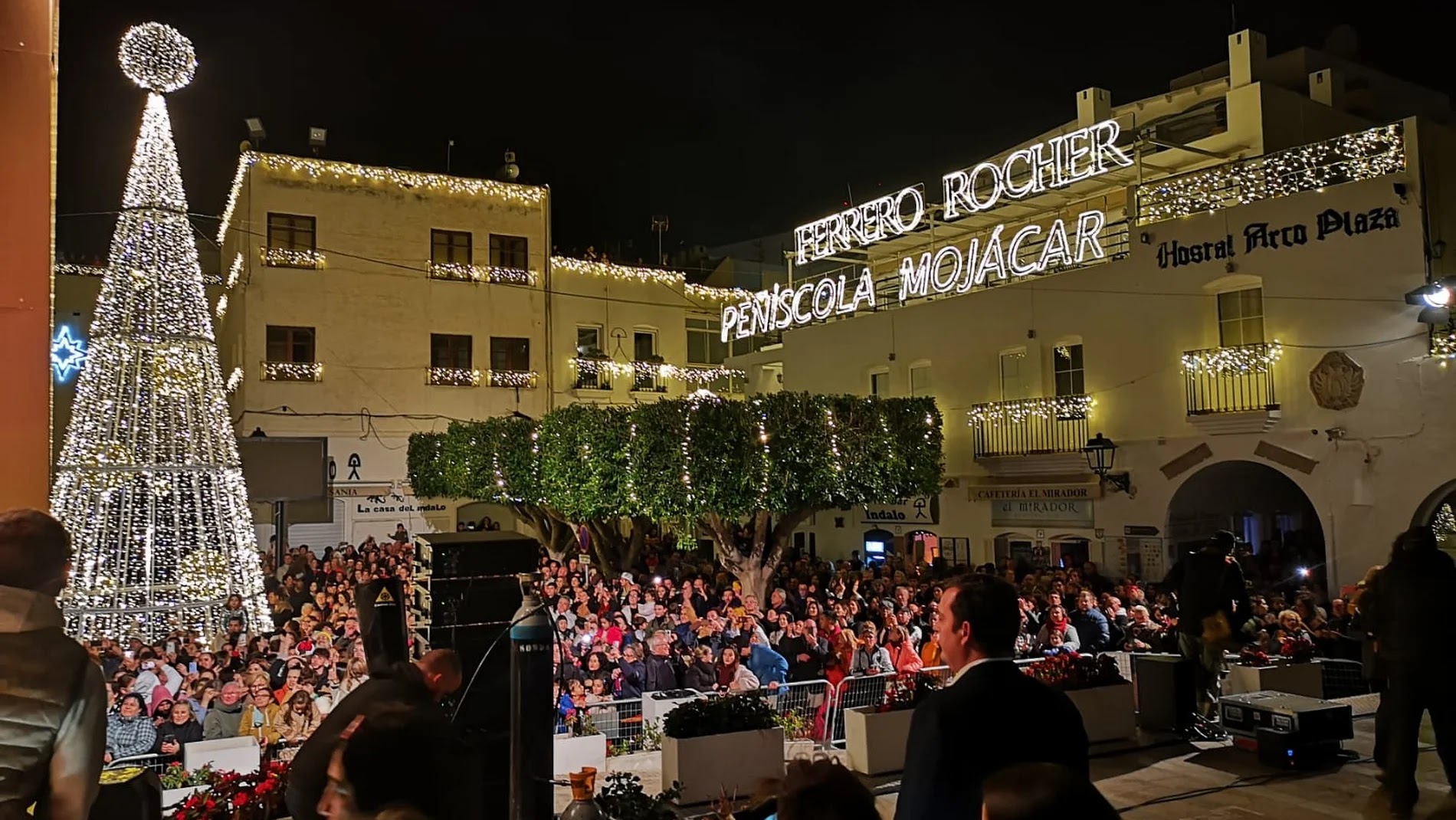
My own adopted town, Mojácar, has enjoyed thousands of pages of copy over Christmas as an Italian chocolate company decided to stump up for the Christmas lights (including its name charmingly blazed across the highest building in the town square). The mayoress is so pleased by the onslaught of visitors (all eyeing with trepidation the fifty or more souvenir shops waiting anxiously for their trade) that she has extended the illumination until, at the very least, the end of January. Unfortunately, the destination’s tour hotels weren’t in on the plot, so they are all seasonally (and firmly) closed.

Meanwhile, the agency that runs ‘Spain’s most beautiful pueblos’ has chalked up another six for 2023, including Trevélez in Granada (a touristy Alpujarran village with good trout and jamón).

Looking for a beautiful village to visit? Trusty old Google throws in its hat with over six million results, including: ‘15 of the most beautiful villages in Spain’ at The Points Guy; ‘The Most Beautiful Towns in Spain’ with Culture Trip; ‘18 Beautiful Towns In Spain To Visit’ from the obscure Hand Luggage Only and from someone we have at least heard of: ‘Spain’s 30 most beautiful villages, as voted for by readers of El País in English’. Nice pictures. Mojácar comes in at Nº27, even though, I think, it's more dramatic than beautiful.

Of course, one always wonders about readers’ votes…

So, as we fill the car once again, only to discover that the twenty per cent gasoline-discount has disappeared, and open the map to our chosen destination for the day, we hope (forlornly?) that it won’t be too full of coaches, tourists and screaming children, and that there will be a parking space somewhere near the restaurant that Tripadvisor enthuses so strongly about.

Spain has something over eight thousand municipalities, and some of them can count on a handful of nice villages all within the same parish. Níjar in Almería - for example - can boast the attractions of the Cabo de Gata, San José, la Isleta del Moro, Agua Amarga, Las Negras, Fernán Pérez, Pozo de los Frailes, Rodalquilar and even Níjar itself (plus another sixteen rather more humdrum settlements besides).

So, between one thing and another, getting out those travel stories are a full job for an editor.

Ask, And You Shall Receive (Maybe)

This one starts with a conversation on Facebook. Somebody posted a question along the lines of: ‘I’ve had it with the UK and I want to move to Spain, is it easy to find a job?’

Us old hands living in Spain for long, longer or longest were happy to post answers to this. Here’s mine:

‘The Spanish won't employ you over their own, or hire you over their own. That's assuming perfect language skills and all papers in order. Thus, you either find a foreign-owned business - a bar, English-language newspaper, real-estate office... or you self-employ. Some of us (and this is frowned on) seek to live by ripping off our fellow countrymen’.

This last bit set the cat among the pigeons.

It seems that I aren’t the only one who has learned through experience not to trust the first person who sidles up to me and says ‘What Ho, Old Stick, Can you lend me a few bob, I’ll pay you back when the cheque arrives from my parents’.

Because, you know, he won’t.

Not that one wishes to discourage those who seek to the leave the Old Country for a better life abroad.

And Life is, after all, an adventure.

Moving to Spain, an excellent place to live, is a good idea. It’s best to have money coming in from outside to keep one in gambas and albariño; perhaps a pension, or some regular dividends, or even a wealthy older brother who subscribes firmly to the aphorism ‘absence makes the heart grow fonder’.

The second-best way is to find a job (like our intrepid Facebook correspondent) with the disadvantages and cautions listed above.

The third (minority) way is to try and snow your fellow countrymen, until such time as circumstances merit a swift departure for somewhere new and innocent.

Beyond being short-changed in a shop, the times I have been conned over my lifetime in Spain has always been by fellow-Brits. A pity really, but there you go. It’s not like it happened every day, but I’ve been living here a long time now…

No doubt the Dutch would say the same thing about their own countrymen, and amen with the Germans and the Danes.

There's a page on Facebook called ‘Named and Shamed, Costa Blanca’. This type of page, of course, can sometimes be counterproductive, and watch out for the legal profession when dropping a literary dime on someone. However, the content will help put us on our guard.

Returning one last time to the thread mentioned above, and how it’s always one’s fellow countrymen and never the Spanish who hand you a sob story or a cunning get-rich-quick scheme that only needs a bit of seed money; Amalia, a woman living in the UK, posted an interesting (bombshell!) observation: ‘I must say this also happens in England between us Spaniards’.

Huh!


Everything That's Runny Contains Water

I saw a billboard today while driving along the main road towards the playa on my way...