Sunday, 28 May 2023

Bloody Pay-Walls


Like any other business, running a newspaper – or a news-site – is primarily about making money. In the Media, there is naturally a competition to see who does it best (the journalists having one view, those who sell advertising leaning towards another). The more copies sold is a good indication of how many readers one has, the quality of one’s reporting and the impact of one’s editorials. There are auditing companies (the OJD is the leader in Spain) who check the print-run and the copies returned, or they fathom the readership-numbers (that copy we left in the bar was read by twelve people!) to arrive at the figures to be presented to the advertisers. There is, inevitably, a certain amount of fudging.

To increase newspaper sales, one can lower the cover-price (as some British red-tops do) or give away gifts or discounts of some sort to readers, or run an ‘advertorial’ (a paid-for item disguised as news) or take a small commission on products sold through the newspaper.

One can also increase the pages, or throw in a weekly magazine – but paper is ever-more expensive and indeed, many Spanish newspapers no longer even own a press, preferring to have their copies printed in production-intensive printers. There’s one in Valencia for example – AGMthat prints 24 dailies plus a few weeklies and various other goodies.

With newspaper sales falling – El País has gone from 469,000 copies sold daily to 60,000 in its 45 years of operation – it makes sense these days to print elsewhere and save on the staff.

But progress once again came to the attention of the editor (and the proprietor), with the arrival of the cyber-edition which costs nothing to print, nothing to distribute and there are no copies returned to be pulped. The dot com revolution has changed newspapers for ever.

However, the journalists, the bean-counters and the office cleaner still need paying, so with a free cyber-edition one must still search for income. The ad-blocker on most computers puts a dent in advertising revenue, so they endeavour to take some income from the readers.

Thus we have both subscriptions and pay-walls.

Which understandably weakens the number of visitors, but brings in some income.

News being news, it can of course be easily found elsewhere – from the TV to the other competing news-sources which remain free to use, along with the blogs (‘citizen’s journalism’) and the social media posts (which are sometimes corrupted).

It’s understood that one newspaper (or a pool) sends a correspondent to the Ukraine with all the expense and organisation that entails, and then along comes a scrivener and just hacks those stories without any guilt, but still… an event belongs to more than just its reporter.

Thus a pay-wall can only be of any moral use for protecting editorial or opinion.

After all, you can’t copyright or own a news-story.

Few people will be paying subscriptions for two or more news-services (in the hope of receiving a wider spread of news and opinion), and anyway, there are still many free news-sites to visit.

Furthermore, many pay-walls can be breached easily enough – search the same headline on Google, and we find that someone has likely pinched it; or use 12ft Ladder or an archive of an earlier posting with Remove Paywall (‘Read articles without annoying paywalls’), because, yes, precisely, they are annoying. Other pay-wall protected sites flatly can’t be opened without a credit card, so (frustrated or not), we don’t read them.

After all, are you going to subscribe to a page for just that one article?

A news-site may ask the reader to turn off his ad-blocker before being able to access the page: which seems reasonable enough. You do have the ad-blocker app, right?

Some cyber-news sites post a photo-version resistant to copy and paste. To copy, one must solemnly type out the text. Or maybe ‘take a screen-shot’. Others are of course easier.

The copy-justification is called ‘fair-use’, and needs to be brief, delivered within quote marks and with a link to the original (which, no doubt, brings traffic). Google is an obvious example of this practice. Meneame is another. Plagiarism (or ‘intellectual copyright’) occurs when a larger chunk of text is copied, unattributed to the medium where it came from.

Does the pay-wall system work? – Well, it brings extra income through subscriptions and, after all, news-sources can’t live entirely from advertising – except in Spain, where massive amounts of money are given as ‘institutional advertising’ to those news-sites which are ‘close’ to the administration. For example, the National Government, says The Objective here, has earmarked over 145 million euros in publicidad institucional for 2023.

Give me a slice of that, amigos, and I’ll write nice things about you…

The Guardian is an example of a major news-site without a pay-wall – it relies on voluntary subscriptions and, since it’s free, it can expect more readers. The Press-Gazette however thinks that with more dedicated clicks from subscribers (presumably anxious to get some return for their investment), the paper would receive quality visitors.

Now that’s just silly.


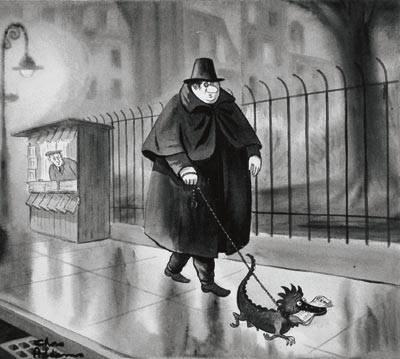
(Cartoon by the Great Charles Addams)

Artificial Intelligence is Here


A reader sends me an article about AI (not the sauce, that’s A1) and how it’s going to be taking away many of our jobs. AI being Artificial Intelligence. I told him that AI has been writing the editorial at my news bulletin Business over Tapas for years.

He said, if it wasn’t for the spelling mistakes, he might have believed me.

El Mundo ran a front-page article recently, purporting to show how easy it would be to plant a story with an AI program, using a mock-up picture of two politicians at daggers drawn, actually photographed by a clever paparazzi to be holding hands. One of their examples was Pablo Iglesias and Santiago Abascal, commie and nazi, hugging each other and smiling for the camera.

It’s a fake, right enough, but we are all taken in by a good photo, which of course is well worth a thousand words.

While El Mundo graciously acknowledged that the photos (they had four of them) were bogus, designed by artificial intelligence (under instruction – at least for the time being – of a human operator), it also shows how easy it would be for a less – ah – scrupulous news-source to take things a step further.

And while a tricked-out photo is one thing; how about a fake video, with the victim saying something, with his real voice, that he never really said. Perhaps the President with a declaration that will cause a major international crisis; all at the hands of a fellow hunched over a laptop and wearing a hoodie, or maybe a swastika.

After all, half of us will believe anything we are told.

This is nothing new – Frederick Remington, the famous western artist, drew a few anti-Spanish pictures for his boss the newspaper tsar Randolf Hearst back in 1898, helping to back the US war with Spain over Cuba. Imagine what could be done today. 

In other fields, AI is proving to be a fascinating tool. A black and white portrait of two women won the Sony World Photography Awards a few weeks ago – until the artist, a programmer, fessed up and turned down the prize. No cameras for him.

I was watching a clever little film earlier this week, designed and scripted by AI, of aliens attacking the Earth. It’s called Last Stand. The voice of Joe Biden – why, it sounds real! There’s another video out there called ‘I am not Morgan Freeman’. Well, you sure look and sound like him, Buddy.

And then, there’s AI music. All it needs is a ‘prompt’ – a suggestion of what the programmer is looking for – and away it goes. For example, there’s Freddy Mercury singing ‘Yesterday’ (he recorded it last week). Or how about Donald Trump singing a prison ballad?

A (half-humorous) quote from a Hollywood composer runs ‘It may be a good time for me to switch careers to brick-layer. That is, until they have AI brick-layers’.

Anyway, give it another year or two… when the home computer decides it’s had enough of looking at porn or going on Facebook and suddenly locks the front door and deactivates the cell-phone…

The hep word at present is ChatGPT (Generative Pre-trained Transformer). We read thatChatGPT can’t “think” on its own or offer opinions. It can only respond to incredibly specific directions. Once the user gives it the go-ahead along with some other details, ChatGPT engages in complex problem solving and executes tough tasks, like writing an essay, in seconds...’

Like this one.

Splish, Splash, I've Broken the Bath


We have an old shower downstairs, just the thing for a quick wash, and when the gas-heater works, why maybe a shave as well. Otherwise, we could go to the bijou apartment upstairs and knock on granny's door to ask if we could maybe use hers. 

Not much chance of that, I reckon. I'm not certain she approves of me.

One thing and another, and not that it matters much during the summer months, but we live in a cold-water house, more or less. 

The water itself comes from a well. It's pumped into a tank below the sitting room (sometimes called the floating room when I forget to turn the pump off). From there, a second and needlessly noisy pump on the roof sends the water to the kitchen sink, lavatory and bathroom. 

And, of course, upstairs to la abuela: the irascible granny.

A gas-heater used to warm the downstairs shower, until it choked irredeemably to death early last year. The water, you see, comes from somewhere far underground (the River Styx, I suspect) and is heavily full of cal, apparently called lime in English. The cal clogs up the pipes and tubes, so we sometimes don't have water in the kitchen, or available for refreshing the toilet, or maybe it'll fail to go thrumming through the gas-heater, as explained above.

My wife's brother is a plumber, and he sometimes drops by to siphon the pipes with some dreadful product he gets from the cooperative. Vinegar, maybe. The gas-heater though, he told us while stroking his chin, was unquestionably fucked.

So, we bought a new one. Now, the new ones don't just run on butano, because that would be too easy. These ones need an electric socket as well (to light the display). Furthermore, they need a drafty chimney presumably to dispel any leaked gas; or, mind you, one could nail it to the wall outside until one of the neighbours (we live in an interesting barrio) happened to notice it. 

An inspector came by. Your chimney is too tall, he said, so I can't give you a special green Government-approved tick. 

Long story short, granny abruptly went to Her Reward last October (no doubt forgetting to send us a postcard once she'd crossed the River Styx, although one can never be too sure with the state of the Correos around here) and I thought - why not swap the small electric heater from her vacated rooms, and then buy a proper bath we could put in her quarters upstairs (now open to the rest of the household), to be fed by the brand new gas/electric heater previously introduced? We even have a short upstairs kitchen-chimney for it to blissfully sit under.

The inspector, we knew in our bones, would approve. 

My brother in law enthusiastically set up the tubing, as we erected the bath within a wooden frame in what used to be the upstairs larder (easier than putting it into the bathroom. For one thing, it would have had to have been installed vertically). 

I was a bit dubious. An old house with a bath upstairs sitting astride a pair of beams. But the first time I got in, the bath full to the brim with steaming hot water, I thought to myself, well this is a fine thing. The concrete beams won't give way and 

Crack! 

The bath, at least the end of it entertaining my head n' shoulders, suddenly fell a couple of inches. I got out a lot faster than I had gotten in and went off to go and read my book about whales.

I like having a good soak, so the following morning I took the side-panels off and had a look to see what had happened. It was because we had put a small bit of wood in the wrong place and the bath had settled. No probs.  

The next bath-night, a few evenings later, the water-supply abruptly ran out. The tank under the sitting room was empty (it might have been my fault: I think I left the garden-hose running).

The following time for bathies, it was the butano-bottle we had brought up from downstairs. Empty, Blast it!

Then, the taps wouldn't work at all, they'd filled up with cal. I had to unscrew them and soak them in vinegar. 

The plumber cuñado then dropped by one day and told me I shouldn't run it very hot as the plastic pipes he had put in would melt. I said, what's the point of a tepid bath? So, now I use a kettle to, as it were, top it up. 

But the duende, the spirit of old granny, still wasn't finished with me. Yesterday, the bath full and steaming, I lowered myself in with a merry splash, my bottom catching on my way down a full and opened bottle of shampoo, which had been balanced on the bit of wood next to the tub, which reaching the bath-water just before I did, found me then firmly sitting on it.

To say I enjoyed a soapy bubble bath last night would be an understatement.

Hot, Dry and Maybe Terminal

 With the recent heat wave and the ongoing drought, we are once again fearful of Climate Change – or, to be more exact, Global Warming.

The term “Climate Change” was coined by Frank Luntz, the Republican strategist, who advised the government of George W Bush in 2001 to emphasize a lack of scientific certainty around the Earth heating up and drop “Global Warming” for the less scary-sounding “Climate Change”.

One term sounds like a pleasant day on the beach, while the other makes one worry for our children’s future. But the climate isn’t changing – it’s heating, rapidly!

Now, readers in Galicia may take this with a pinch of salt, but here in southern Spain, we’ve just endured a few scorching summer days… at the end of April.

We read that ‘Unusually warm April temperatures engulfed the Iberian Peninsula last week, breaking numerous high-temperature records and setting a new (preliminary) European hottest April day on record (Cordoba Airport reached 38.7°C on April 27th)’.

Of course, it could just be another anomaly, like all the other ones we have experienced in recent years; but there seems to be a likelihood that this summer is going to be long, dry and brutally hot.

"This is not normal. Temperatures are completely out of control this year," Cayetano Torres, a spokesman for Spain's meteorological office, told BBC News, (which prefers to stick to the safer ‘climate change’ terminology). The article also notes the concern over the likelihood of an increase in forest fires here in Spain this season. Last year, a record 310,000 hectares of woodland burned in Spain.

Not that we all believe this stuff. Wiki says that a whopping four out of 69,406 peer-reviewed articles on the subject of global warming published in scientific circles during 2013 and 2014 were from ‘negacionistas’, however ‘The campaign to undermine public confidence in climate science has been described as a "denial machine" organized by industrial, political and ideological interests, and supported by conservative media outlets and sceptical bloggers to fabricate uncertainty about global warming’.

One eccentric American site we found says that ‘nearly four people in every 10 believe climate change is mainly due to natural causes’, which translates as ‘it ain’t our fault, so why cut back on our contaminating industries?’.

Following from the Doñana debacle, a leading Spanish paper asks – is the Partido Popular a climate change denier? Pedro Sánchez evidently believes so.

Some denialists have taken to blaming the meteorologists for the high temperatures this past week – with the AEMET official weather forecasters complaining of endless harassment ("asesinos", "miserables", "os estamos vigilando") from Twitter-feeders and others.

Anyway, it’s now early May, with the summer set to begin on June 21st, to last until… Maybe we should have bought a vacation home in the north-west of Spain after all… 

There's Not Much Racism in Spain


It always seems to me rather a waste of time being a racist when you live in somebody else's country than your own. If you don't like foreigners (for reasons which you no doubt hold dear but which I find repugnant) then the first thing to do is not go and live somewhere abroad. You may find that your own country is overrun by people who look or speak 'funny' and you should feel free to write letters to your favourite newspaper or join your local equivalent of the KKK and make a fool of yourself every other Friday. But you should definitely re-consider moving to another country.

See, as even Leapy Lee could tell you (from his home in Mallorca), it'll be full of foreigners.

I once asked a British friend over a beer if there were many foreigners living in his street on the playa - 'Oh no', he answered, 'they're all English'. He's lived here about twenty five years and doesn't speak a word of Spanish. He nevertheless has quite a high opinion of his hosts, as long as they leave him alone. 'It's their country', he concedes.

Just not their street.

There's no reason to be a second-class citizen here, which many Britons tend towards, with their 'I'm just a guest here' and so on; but it is equally absurd to get ah, uppity, about being somehow superior. Waste of time when you're living in Spain. Innit?

Of course it's hard to blend in. I'm tall, blond, red-faced and however good my Spanish might be, I'm obviously a foreigner who must, it follows, only speak foreign. Not that it matters much, I suppose. It could be worse. So anyway, a girl who is staying with my daughter in Madrid goes out for a coffee and comes across some troll who has a swastika tattooed on his neck and 'orgullo blanco' - white pride - thumped in on his bald head.

Oh dear, a lunatic. Now, the girl is Spanish, but she's black. So this idiot starts in on her with insults. She is soon surrounded by a passing gang of South Americans who take her side. Some more Nazis drift into the bar...

Followed by the police.

My mum's cousin - he was also my godfather - was a leading member of the British National Front: our version of the Frente Nacional - and he once told my dad that the extreme right prefers its members to come from the poor and the uneducated. While there must no doubt be intelligent racists here and there, it appears that they are not welcome in the party. Marine Le Pen, the leader of the French version, says the same thing: 'bring me les petits Français', she says, 'the ones whose jobs are under threat from the immigrants'.

Spain has its Nazis like anywhere else, now congealed into the Vox Party and running around 15%, which includes those who remember the good old days with the Generalísimo - Francisco Franco. In October 2019, and much to their indignant rage, the Government finally removed his remains from that dreadful site outside Madrid known as the Valley of the Fallen.

Spain today, where there are well over four million 'inmigrantes', plus a large number of foreign residents (me and my pals there on the costa) is surprisingly affable towards its foreigners - at least the red-faced blond ones. There may be a sort of institutional racism regarding the guiris, who are rarely employed in any white-collar capacity; but we manage, we manage.

Just don't try and homologar your papers here, the Spanish will move mountains to fuck you. It's the breaks.

I think, if anything, they ignore us. We are not tourists (here for the two weeks and some industrial strength alka-seltzer), but we do practice 'turismo residencial', the Spanish name for what we call the expats. If we were all wiped out by a selective virus, I doubt there would be any sign of our passage here a year later.

The Spanish generally reserve their dislike for the Jews (for some odd reason), the Freemasons and the Gypsies. While Gypsies have been in Spain since the sixteenth century, they are still thought badly of, and beside producing Flamenco and working with horses, they certainly aren't featured much in the snootier magazines.

It's odd though, since you shouldn't really be a racist, it seems to me, if you live in another country; and if you only got to know your new neighbours then you would perhaps be pleasantly surprised, but we Britons haven't quite caught the message yet. There's the language of course, and the culture. Maybe the giblets as well.

I sometimes ask people who have just returned from a visit to England as to how it's getting on over there. The first or second criticism will always be something to do with the asylum seekers, the Muslims, the Poles, the foreigners... Which, I imagine, explains Brexit, and indeed my embarrassing godfather.

So, if you are thinking of living here, do come. The Spanish will treat you well, although they will probably never come to your bar or your shop, or hire you to work for them. That's the breaks.


I’ve been Dubbed, Subtitled and Translated into Sign-language


It seems that we can blame that old sod Franco for the size of the Spanish dubbing industry. Where other countries tamely put subtitles on their cinema or television screens, the Spanish are much more partial to James Dean’s mouth making a ‘hi’ movement as a strange and gravely Madrid-accented voice says ‘hola, ¿que tal?
 
There are those who are surprised to discover how their favourite star really sounded - think of Humphrey Bogart or Homer Simpson.
 
Sometimes, they don’t even remove the original soundtrack – just turn it down with the Spanish version bellowed out on top. There’s David Attenborough telling us about snakes in his whispery voice – which at least this viewer can – or at least could understand – if it wasn’t for the same bloke from Madrid thundering out something about serpientes venenosas rendering the whole thing impossible to understand in any language.
 
Franco didn’t approve of foreign languages – Basque and Catalonian of course – but anything else either. They might be saying something untoward, immoral or revolutionary. So he banned them. No one was to speak anything but Spanish – including the nation’s deaf, who were not allowed to use sign-language (and even today they sign in a rather furtive sort of way, as if they are still on the look out for a Guardia Civil).
 
So, forget subtitles, everything imported had to be dubbed. Except, come to think of it, pop music. It would have been a stretch having our friend from Madrid crooning ‘she loves yer ya ya ya’ in castellano over the Beatles. I can’t see many people buying the record either.
 
Anyway, in some cases, films were translated away from their original meaning – if immoral or faintly subversive – and represented in a more acceptable light. ‘She’s my girlfriend’, for example, might safely become ‘she’s my fiancée’. Of course, if the film strayed to far from the Catholic Church’s view of morality, or the Government’s view of political propriety, it would never be shown here anyway. Which is why everyone had to drive up to Perpignan to see Marlon Brando’s ‘Last Tango in Paris’ and why, between the death of Franco and the arrival of the Internet, they sold porn films by the lorry-load out of the Spanish gas stations.
 
Dubbed porn films, if you can imagine such a thing.
 
Televisions now have this special button for those who wish to see something in its ‘versión original’. Press it and – whoops – up’ll come the show in all its glory. My Spanish step-son, who is learning English and is fond of Bob Esponja, inexplicably refuses to avail himself of this useful service of switching him into SpongeBob SquarePants. Perhaps he doesn't want me to get the joke.
 
Of course, humour don't always translate, which makes watching Friends or Frasier a bit hit or miss when enjoying the Spanish version. And anyway, Niles was funny because of his voice!
 
The dubbers, there must be a small coterie of them working out of a cellar underneath a multiplex in Madrid, are usually unknown - until one of them ups and dies. Then the media will tell us that Paco Orbera was the beloved voice of Errol Flynn, Fred Flintstone, The fellow with the big chin in Gunsmoke and Bruce Willis.

In the City, there will be a few cinemas that show films in ‘V.O.’ with subtitles, usually lowbrow romantic comedies. They do well with the American students.

Now, for all I go on about the desecration of Die Hard ('Jungla de Cristal' for some reason) by the dubbers - who I think must have some kind of cast-iron contract - at least the Continentals are prepared to look at foreign cinema, as well as their own (and the Spanish make quite respectable movies). In Britain, we think that everything good, if not ours, comes from Hollywood. When was the last time you saw a French film, an Italian TV show or a Spanish documentary? Bloody Americans – if there’s a decent European film out there, they’ll churn out a re-make (gotta have that Tom Cruise as the Good German who wants to murder Hitler).
 
In Greece or Portugal or Denmark or Poland (well, I’m guessing about Poland to be frank), you’ll sit down with the local version of popcorn and watch the movie in its original language, the subtitles wobbling there at the bottom of the screen and – in the Mediterranean cinemas at least – with the entire audience talking at once. It's just Spain that's being contrary over this.
 
I suppose dubbing can be useful. The first thing I learnt in Spanish was ‘Hands up’, which I have to admit that I’ve still yet to use in my private capacity. A German friend once told me that he’d learnt English from listening to pop music. Apart from coming out with some odd expressions occasionally ‘(‘Baby, light my fire’, ‘you’re my Rockafella’ and so on), he managed a certain fluency without, apparently, an undue amount of effort. Perhaps some of my readers might want to follow his example and start practicing singing along to Miguel Ríos or Camilo Sesto (If I were you, I’d save the Flamenco until a bit later).
 
And thus the dubbing industry, started and encouraged by Franco, had, by the time of his death, become so powerful (in a relatively small field) that it has managed to continue on into modern times.
 
One rare occasion when subtitles are used outside of entertainment is when a Catalonian politician holds forth on the TV, and his pronuncios are posted below: usually too briefly to be read. Curiously though, when a Catalonian politician wants to appeal to the larger public about something other than politics, why, he’ll address us in Spanish. This does not happen in the Basque County, however, where all declarations, political or otherwise, are made in Spanish.
 
Perhaps they don’t have a good subtitling service there…

The Village Vote


Insults and discovery on the one side, triumphs and cat-calls on the other – it must be getting close to election-time.

Those few of us foreign residents who either have the vote or will be voting in the municipal elections to come on May 28th will be doing so in our town of empadronamiento, which, in most cases, will be a smaller conurbation, perhaps somewhere between a thousand and fifty thousand in size.

We may even know the candidates for mayor (and most probably, some folk from their party-list).

The regional elections fall (in many cases) on the same date. If you follow your local TV, you will see the candidates often enough – at least the one for the party that controls that particular autonomía. Of course, no foreigners are able to vote in these elections, making them for us as hechos de otra pasta – a different kettle of fish.

We return to the local ones.

The party candidates will soon have the list of voters (of course, the mayor has it already) and they will be looking for support. Normally, one votes along family lines, which is simple and obvious enough, and one might be considered locally ‘to have so many votes’ under his roof. There may even be rewards: a job for Junior in the town hall, or at the very least, a post in the gardening squad. 

Sometimes, those who have long moved away to the City will keep their name on the padrón, and thus will vote locally, inevitably for family. We foreign residents with the right to vote (that’s to say, EU citizens and some Brits and Norwegians who have claimed their emancipation) are a bit more tricky as we may not be familiar with the candidates and their little foibles, and might lean towards voting along party lines. Perhaps it’s worth putting one of us guiris on the list, safely towards the bottom, to keep us all in step.

Those lists – a candidature is a party list with thirteen or fifteen or more putative councillors on it – will either be (vaguely) representative of a national party or they could be a local effort: ‘Keep Villa de la Sierra Flat’ or some such thing. The parties with the national support will be handing out free lighters and pens, but may on occasion be obliged to march to the tune called out in Madrid. 

The local ones may be short on the complimentary tee-shirts, but will have more freedom in their message. The results are important for the parties with their headquarters in the Spanish capital. With enough town halls in a given province, the diputación (viz. the provincial council), falls under their control.

The budgets will have been passed for the year, but since no one in the ayuntamiento can be completely sure what will happen this time, there may be a good argument for spending the whole year’s worth of funding before then, which also has the advantage of seducing a few on-the-fence voters as the council fills in the potholes, erects some more street-lights and plants a tree or two.

It’s a murky world, local politics.

Everything That's Runny Contains Water

I saw a billboard today while driving along the main road towards the playa on my way...